
Shield Your Savings
The world of mutual funds offers a path to financial growth, but it also attracts cybercriminals seeking to exploit unsuspecting investors.

Here are 11 recent cyber fraud techniques making headlines, specifically relevant to mutual fund investors, to help you safeguard your hard-earned money.
Fake KYC verification
Cybercriminals might call you pretending to be bank/mutual fund representatives and request your KYC details for verification. They might even try to convince you to install remote access software to "help" you with the process. Mutual Fund related KYC can always be verified from KYC Registration Agency (KRA) websites directly.
Links for checking your KYC status
Phishing for Fund Logins
Emails or calls claiming to be from your mutual fund company (AMC) requesting urgent action to "verify your account" or avoid "service interruptions" are a red flag. Never click on links or share personal information through unsolicited channels.
"Get Rich Quick" Investment Schemes
Beware of unsolicited investment advice, especially via social media or email. Promises of unrealistic returns or pressure to invest quickly in "hot new funds or stocks" are strong indicators of fraud.
Fake Investment Apps
These malicious apps masquerade as legitimate platforms for trading stocks, cryptocurrency, or mutual funds. They can be found in unofficial app stores or through deceptive advertising. Once downloaded, these apps can steal your financial information in several ways.
Tech Support Scams with a Twist
Pop-up warnings claiming your device is infected and linked to your mutual fund accounts are a tactic to steal login credentials. Don't call the provided number; contact your AMC directly through verified channels.
Smishing About Statements
Spammy text messages (smishing) can appear to come from your AMC, urging you to click on a link to "view your latest statement." Never click on suspicious links; access your statements through the official AMC website or app.
Fake Charity and "Cause Investing" Scams
Cybercriminals may exploit your desire to invest with a social conscience. Research any charity or "cause investing" opportunity thoroughly before donating or investing.
Investment Advisor Impersonation
Fraudsters might pose as financial advisors, offering "exclusive investment opportunities" or manipulating victims into making risky decisions. Verify the advisor's credentials through your AMC or relevant financial institutions.
Adding to Investment Tips Groups
Scammers are gaining access to phone numbers and adding unsuspecting users to WhatsApp and Instagram groups. These groups often spread misinformation or promote fake stock tips. Update your WhatsApp settings to allow only your contacts to add you to groups. While Instagram does not provide any direct way to prevent this, but you can alwasy report the scammer and leave the chat.
Fake Invoice Scams
Be wary of invoices for "processing fees" or "account maintenance" from unknown senders. Verify the information directly with your AMC before making any payments.
Romance Scams Targeting Investors
Fraudulent relationships built online can exploit your financial security. Don't share personal financial information or invest based on someone you haven't met in person and verified.
Data Breaches and Identity Theft
While not a direct scam, data breaches can expose your personal information. Use strong, unique passwords for all your financial accounts and enable two-factor authentication wherever possible.
Remember
- Stay informed: Regularly check your account statements and contact your AMC if you notice any suspicious activity.
- Be skeptical: Don't fall for pressure tactics or promises of unrealistic returns.
- Verify everything: Always confirm information directly with your AMC before taking any action.
- Report suspicious activity: Inform your AMC and report the scam by calling the National Cyber Crime helpline at 1930.
- Also, complain on National Cyber Crime Reporting Portal https://www.cybercrime.gov.in/
By staying vigilant and informed, you can protect your mutual fund investments and build a secure financial future.


Mutual fund updates, SIP tips, and what's moving the market. No daily noise — only when there's something worth reading.
Read more about
- Welcome to Meta Investment blogFunds
- Taxation on Liquid Funds - Updated for Finance Bill 2023 (Budget 2023)
- ESG Investing in India: Unlocking Sustainable Growth Opportunities
- Achieving Milestones: Running and SIP - A Journey of Consistency and Wealth Accumulation
- Lucrative Investment Opportunities Options for NRIs in India
- The Power of Chai, SIP, and Building Long-Term Wealth
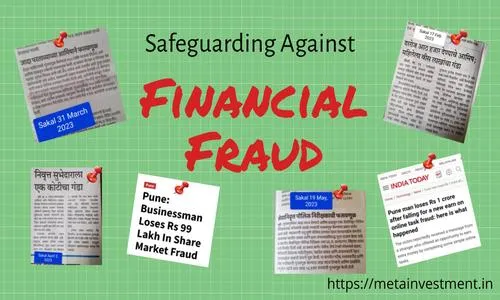
- Your Guid to Safeguarding Against Financial Frauds
- New SEBI Proposal for Mutual Fund Nominee
- Unlocking Your Life Goals - Overcoming Financial Barriers with Smart Investments
- Trust MF launches Flexicap Fund NFO
- Celebrate Earth Day by Investing Sustainably
- From Appathon to SIPathon
- Building Your Crorepati Dream
- Unveiling the Secrets of Wealth
- The Cafe vs. The Nest Egg
- Daughters Who Know Dough
- New KYC Norms
- Gold: A Timeless Investment - How Mutual Funds Make It Easier
- Riding the Consumer Wave: Exploring Non-Cyclical Consumer Index Fund
- Diversifying Your Investments: Multi Cap vs. Flexi Cap vs. Multi Asset Mutual Funds
- Don't Be a Target: Investor Awareness and ARN Verification to avoid Mutual Fund fraud
- Beyond Market Caps: Unveiling Factor Investing with Mutual Funds in India
- Anchoring Your Portfolio: Why Fixed Income Products Deserve a Place in Your Investment Journey
- Rev Up Your Portfolio: SBI Mutual Fund Launches SBI Automotive Opportunities Fund NFO!
- Strava and SIPs: How One Cyclist Conquered Both Roads and Finances
- Don't Panic Sell!
- Growing Their Future: Why Mutual Funds Are a Smart Investment for Minors
- Investing in India's Defence Sector
- Sharma Ji Ke Papa
- How To Lose 1 Crore Rupees
- Yoga of Investing with Bachat Babu
- Mutual Fund Mystery: Online Platform, Missing Money?
- Top 10 Reasons Motilal Oswal's FAB Plan Can Be Your Retirement Buddy!
- The Mutual Fund That Invests in Other Mutual Funds
- The Lazy Investor's Guide to Beating the Market
- Why Large-Cap Mutual Funds are a Smart Investment Choice in India Now?
- One Idiot: A Movie Where the Only Idiot is the One Who Doesn't Watch It (Probably)
- Journey to Financial Independence
- The Gift That Keeps on Giving
- Large and Mid Cap Mutual Funds: The Best of Both Worlds
- 5 Ganesha Mantras for Successful Investing
- Understanding 1st Capital Market Index Fund of India
- Conquer Your 10 Financial Demons This Dussehara
- Motilal Oswal Digital India Fund NFO
- Why Now is a Good Time to Consider Target Maturity Index Funds
- Don't invest this Diwali
- 📢📢 Buy gold in a new avatar, this Dhanteras!
- Multi Sector Rotation Fund: A New Player in the Market
- Coming Soon, Mutual Fund Lite
- A New Year, A New Chapter for Your Wealth
- The Ever-Shifting Sands: Why Asset Allocation is Key to Investment Success
- Quality Investing Through Mutual Funds in India
- Understanding Risk-On and Risk-Off Environments in the Stock Market
- Forgot Your Mutual Fund Investments? MITRA Can Help You Find Them!
- Unlock Financial Wisdom at PIFAA Smart Money Seminar 2025 in PCMC!
- Wishing You a Prosperous Gudi Padwa, Ugadi, Cheiraoba, Navreh, and Cheti Chand!
- Master Market Volatility: Krishan Sharma’s Investing Wisdom
- World Health Day 2025: Why Health Insurance & Financial Planning Matter for Women
- Gold vs. Mutual Funds vs. Multi-Asset Funds: Best Investment for Akshaya Tritiya 2025
- HDFC Innovation Fund NFO 2025 – Invest in India’s Growth Story | Returns, Fund Manager & Performance
- Nido Home Finance NCD 2025: Secure 10.75% Returns | CRISIL A+ Rated Investment
- म्युच्युअल फंड: अल्पवयीन मुलांसाठी स्मार्ट गुंतवणूक का आहे?
- मोतीलाल ओसवालचा FAB प्लान तुमचा सेवानिवृत्तीचा साथीदार का असू शकतो? याची टॉप 10 कारणे!
- तुम्हाला गुढी पाडवा, उगादी, चेइराओबा, नवरेह आणि चेटीचंदच्या हार्दिक शुभेच्छा!
- बाजारातील चढ-उतारांवर मात करा: कृष्ण शर्मा यांच्याकडून महत्त्वाचे धडे
- विश्व आरोग्य दिन २०२५: महिलांसाठी आरोग्य विमा आणि आर्थिक नियोजन का महत्त्वाचे आहे
- सोने vs म्युच्युअल फंड vs मल्टी-अॅसेट फंड: अक्षय तृतीया २०२५ साठी सर्वोत्तम गुंतवणूक
Related Posts


This communication is intended solely for general educational and informational purposes. The information provided is general in nature and does not take into account the specific financial goals, risk profile, investment horizon, financial circumstances or other requirements of any particular investor. It should not be construed as personalised investment advice or as a recommendation to buy, sell or hold any specific financial product.
Mutual Fund investments are subject to market risks. Please read all scheme-related documents carefully before investing. Past performance is not indicative of future results and may not be sustained.
The suitability of any mutual fund product, scheme, category or strategy discussed on this page depends on an investor's individual circumstances, including financial goals, risk appetite, investment horizon and liquidity requirements. Investors should independently assess suitability and, where appropriate, seek professional advice before making investment decisions.
Meta Investment is an AMFI-registered Mutual Fund Distributor (ARN-129322) and is not a SEBI-registered Investment Adviser. If investments are made through a mutual fund distributor, the distributor may receive commission from Asset Management Companies in respect of eligible Regular Plan investments. Commission structures may vary across schemes and AMCs. Such commissions should not influence suitability-based recommendations, and applicable conflicts of interest will be disclosed. Please refer to our Commission Disclosure for further details.
Tax treatment of mutual fund investments depends on individual circumstances and prevailing tax laws, which are subject to change. Investors should consult a qualified tax professional for advice specific to their circumstances.
This disclaimer is intended to provide general disclosure and does not replace any scheme-specific disclosures, risk factors, regulatory disclosures or information contained in the applicable Scheme Information Document (SID), Statement of Additional Information (SAI) and Key Information Memorandum (KIM).
Distributor Disclosure: Where this content is provided by a distributor/intermediary, any applicable commission, remuneration, affiliation or other material conflict of interest shall be disclosed separately. The availability of a product through the distributor does not by itself imply that the product is suitable for every investor.
No Guarantee: No statement on this page should be interpreted as a promise, assurance or guarantee of returns or investment outcomes.
Meta Investment – Your Investment and Insurance Companion