

Peer to Peer Lending
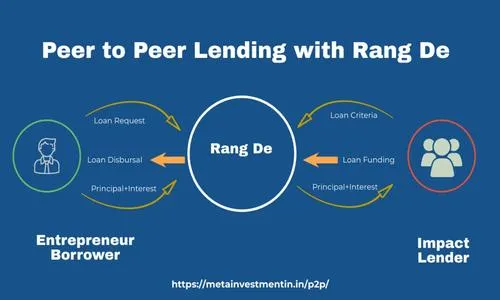
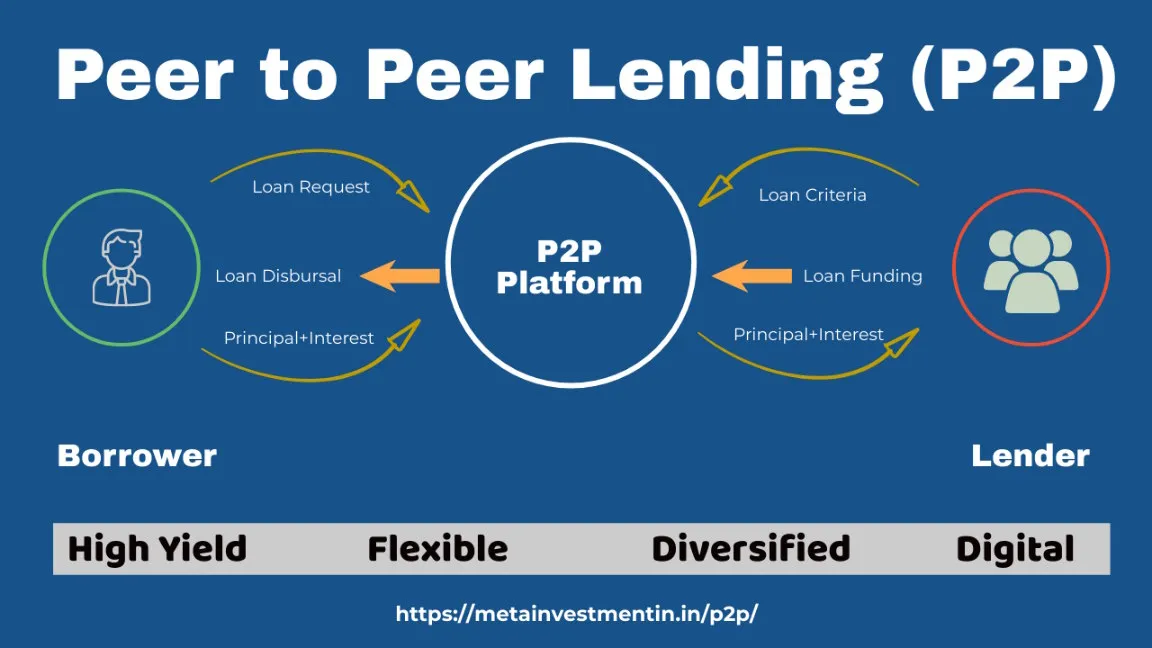 Peer to Peer (P2P) lending is a relatively new concept in India, which has gained popularity in recent years. It is an online lending platform that connects borrowers and lenders directly without any involvement from traditional financial institutions like banks. These various lending platforms are regulated by RBI (Reserve Bank of India) under NBFC-P2P guidelines. As lenders lend money directly to the borrowers it results in less expensive loans for borrowers but at the same time, better risk-adjusted returns for investors. P2P lending platforms use sophisticated algorithms and data analytics to match borrowers with investors based on their creditworthiness, risk profile, and other relevant factors.
Benefits of P2P Lending in India
Access to Credit P2P lending platforms provide access to credit to individuals who are unable to obtain loans from traditional financial institutions like banks. This is especially true for borrowers with poor credit scores or no credit history. P2P lending platforms use alternative credit scoring models to evaluate a borrower's creditworthiness, which allows them to offer loans to a broader range of borrowers.
Lower Interest Rates P2P lending platforms offer loans at lower interest rates than traditional financial institutions like banks. This is because they have lower overhead costs and do not have to maintain physical branches or employ a large workforce. Lower interest rates make borrowing more affordable and can help borrowers save money on interest payments.
Diversification of Investments P2P lending platforms provide an opportunity for investors to diversify their investments by investing in a range of loans with varying risk profiles. This diversification helps investors to spread their risk and reduce the impact of defaults on their overall portfolio.
Challenges of P2P Lending in India
Lack of Regulation P2P lending is a new concept in India, and there is no specific regulation governing its operations. While the Reserve Bank of India (RBI) has issued guidelines for P2P lending platforms, there is no specific regulatory framework for the industry. This lack of regulation creates a risk for both borrowers and lenders.
Default Risk P2P lending involves lending money to individuals who may not have a strong credit history or may have a high risk of default. This default risk can lead to losses for lenders who invest in such loans. P2P lending platforms try to mitigate this risk by using sophisticated algorithms and data analytics to evaluate a borrower's creditworthiness.
P2P Lending Eligibility
As per RBI’s directives, an entity with valid KYC documents (PAN Card, Address Proof, Indian Bank Account, Email Id & Mobile No.) can lend via a Peer-to-Peer Platform. Eligible Entities include:
- Individual (18 years old or above)
- HUF
- Corporate (Incorporated under Indian Companies Act or RBI Listed Finance Companies)
- Partnership Firm
- Limited Liability Partnership (LLP)
- Body of Individuals
- Society
- Artificial Body
How much I can invest/borrow on P2P platforms?
Any individual entity can lend up INR. 50 lakhs across all P2P lending platforms, where as it can borrow loans up to 10 lakhs INR.
How to get started?
P2P lending is a new and innovative concept in India that offers an alternative source of credit to borrowers who are unable to obtain loans from traditional financial institutions. The industry is still evolving, and there are challenges to its growth, including lack of regulation and default risk. However, P2P lending has the potential to revolutionize the lending industry in India by providing affordable credit to a wider range of borrowers and offering investors an opportunity to diversify their investments. As the industry matures and gains wider acceptance, it has the potential to become a significant player in the Indian financial ecosystem.
To understand more about P2P lending/borrowing you can contact us over phone/email/WhatsApp.
LIQUILOANS is one major CRISIL assessed P2P platform. To register with LiquiLoan as invester click here and follow simple instructions.



This communication is intended solely for general educational and informational purposes. The information provided is general in nature and does not take into account the specific financial goals, risk profile, investment horizon, financial circumstances or other requirements of any particular investor. It should not be construed as personalised investment advice or as a recommendation to buy, sell or hold any specific financial product.
Mutual Fund investments are subject to market risks. Please read all scheme-related documents carefully before investing. Past performance is not indicative of future results and may not be sustained.
The suitability of any mutual fund product, scheme, category or strategy discussed on this page depends on an investor's individual circumstances, including financial goals, risk appetite, investment horizon and liquidity requirements. Investors should independently assess suitability and, where appropriate, seek professional advice before making investment decisions.
Meta Investment is an AMFI-registered Mutual Fund Distributor (ARN-129322) and is not a SEBI-registered Investment Adviser. If investments are made through a mutual fund distributor, the distributor may receive commission from Asset Management Companies in respect of eligible Regular Plan investments. Commission structures may vary across schemes and AMCs. Such commissions should not influence suitability-based recommendations, and applicable conflicts of interest will be disclosed. Please refer to our Commission Disclosure for further details.
Tax treatment of mutual fund investments depends on individual circumstances and prevailing tax laws, which are subject to change. Investors should consult a qualified tax professional for advice specific to their circumstances.
This disclaimer is intended to provide general disclosure and does not replace any scheme-specific disclosures, risk factors, regulatory disclosures or information contained in the applicable Scheme Information Document (SID), Statement of Additional Information (SAI) and Key Information Memorandum (KIM).
Distributor Disclosure: Where this content is provided by a distributor/intermediary, any applicable commission, remuneration, affiliation or other material conflict of interest shall be disclosed separately. The availability of a product through the distributor does not by itself imply that the product is suitable for every investor.
No Guarantee: No statement on this page should be interpreted as a promise, assurance or guarantee of returns or investment outcomes.
Meta Investment – Your Investment and Insurance Companion
Mutual fund updates, SIP tips, and what's moving the market. No daily noise — only when there's something worth reading.