
Adani Enterprises NCDs 2025 – Safe Investment with 9.3% Returns?
Adani Enterprises NCDs: A High-Yield, Secured Investment Opportunity
Adani Enterprises Limited (AEL) has announced a public issue of secured, redeemable Non-Convertible Debentures (NCDs) worth ₹1,000 crore, offering attractive interest rates up to 9.3% per annum.
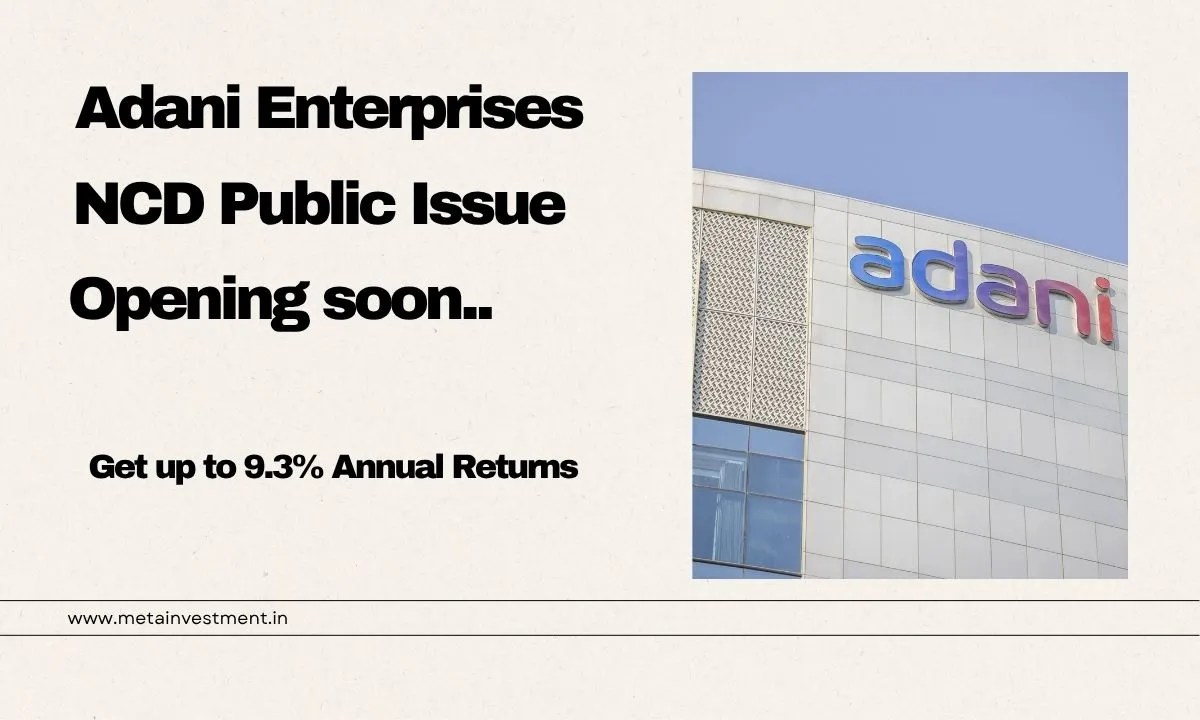
With the issue opening on July 9, 2025, investors are evaluating whether this fits their portfolio. Here’s a detailed analysis to help you decide.
Key Features of Adani Enterprises NCDs
-
Issue Details:
- Face Value: ₹1,000 per NCD
- Base Issue Size: ₹500 crore (with a ₹500 crore greenshoe option).
- Credit Rating: AA-/Stable by CARE & ICRA (moderate safety).
- Security Cover: 1.10X, implying lower risk of default.
-
Tenure & Returns:
- Short-Term (24 months): 8.95% p.a. (annual payout) or 8.95% effective yield (cumulative).
- Medium-Term (36–60 months): Up to 9.3% p.a. (highest for 60-month annual option).
- Redemption Value: Cumulative options offer ₹1,560.29 per NCD after 5 years.
-
Allocation:
- 30% reserved for retail investors, 30% for HNIs.
Why Consider Adani NCDs?
- Higher Returns: Beats most bank FDs (currently 6–7.5% p.a.) and government bonds.
- Secured Instrument: Backed by AEL’s assets, reducing default risk.
- Diversified Business: AEL operates in airports, green energy, mining, and logistics, ensuring stable cash flows.
- Strong Financials: FY25 profit rose to ₹6,053 crore (up 113% YoY), with EBITDA at ₹8,067 crore.
Risks to Evaluate
- Sectoral Exposure: AEL’s revenue from coal mining and airports is tied to regulatory and commodity risks.
- Leverage: Debt-to-equity ratio rose to 0.47 in FY25 (from 0.21 in FY23), though still manageable.
- Interest Rate Risk: If RBI hikes rates, newer NCDs may offer better returns.
Who Should Invest?
- Conservative Investors: Preferring secured, fixed-income instruments over equities.
- High-Income Earners: Seeking tax-efficient returns (indexation benefits apply for long-term holdings).
- Portfolio Diversifiers: Allocating 10–20% to corporate debt for stability.
Avoid If: You seek liquidity (NCDs trade on exchanges but may have low volumes) or higher capital appreciation (equities may suit better).
How to Apply?
- Dates: July 9–22, 2025.
- Minimum Investment: ₹10,000 (10 NCDs).
- Process: Contact Meta Investment for complete online application process and pre-book your application.
Final Verdict
Adani’s NCDs are a moderate-risk, high-reward option for investors comfortable with AA- ratings and Adani Group’s growth trajectory. With a 9.3% yield, they outperform traditional fixed deposits, but weigh the risks against your financial goals.
Pro Tip: Compare with similar-rated NCDs (e.g., L&T Finance, Tata Capital) and consult a financial advisor.
Disclaimer: This is not investment advice. Read the prospectus and assess risks before investing.
Explore More: Adani Enterprises NCD Prospectus - SEBI Guidelines
Frequently Asked Questions
What are Adani Enterprises NCDs?
Adani Enterprises Limited (AEL) is issuing secured, redeemable Non-Convertible Debentures (NCDs) with face value ₹1,000 each. These are fixed-income instruments offering 8.95% to 9.3% annual returns, with tenures ranging from 2 to 5 years.
What is the credit rating of these NCDs?
The NCDs are rated AA-/Stable by CARE Ratings and ICRA, indicating moderate safety with a low risk of default.
How safe is this investment?
Secured: Backed by AEL’s assets (1.10X security cover). Stable issuer: Adani Enterprises has diversified businesses (airports, green energy, mining). Strong financials: Profit doubled to ₹6,053 crore in FY25.
What are the interest payment options?
Annual payout (e.g., 9.3% for 60-month Series VII). Quarterly payout (e.g., 9.0% for 60-month Series VI). Cumulative option (interest compounded; redeemed at maturity).
What is the minimum investment amount?
₹10,000 (10 NCDs) and in multiples of ₹1,000 thereafter.
Are these NCDs listed on stock exchanges?
Yes, they will be listed on BSE and MSE, providing liquidity. However, secondary market trading may have low volumes.
What are the tax implications?
Interest income is taxable as per your income slab. Capital gains: Short-term (≤ 2 years): 20%. Long-term (< 3 years): 12.5%.
Who should invest in these NCDs?
Risk-averse investors seeking higher returns than FDs. High-net-worth individuals (HNIs) looking for fixed-income diversification. Retail investors with a 3-5 year horizon.
Should I invest in Adani NCDs or other fixed-income options?
Better than FDs: Higher yield (9.3% vs. 6-7.5% in banks). Riskier than govt bonds: But offers better returns. Alternative: Compare with similar-rated NCDs (e.g., Edelweiss, L&T, Tata Capital).


Mutual fund updates, SIP tips, and what's moving the market. No daily noise — only when there's something worth reading.
Read more about
- Better returns with Bonds
- EMI vs SIP
- From Millennials To Millionaires
- Berar Aug'22 Bond's
- Rupeek Bonds
- Investing for Building Wealth: What Cricket Can Teach Us
- 5 Steps to Getting Started in Investing for Young Indians
- Happy Akshaya Trithiya
- Impact Investing with P2P Lending
- The Power of Chai, SIP, and Building Long-Term Wealth
- Balancing Financial Independence - Drawing Lessons from Shivaji Maharaj
- Barni's Magic: Rani's Financial Adventure
- Sovereign Gold Bond 2023 Tranch II
- 🌟 Exclusive Ganesh Chaturthi Offer 🌟
- ULIP vs Mutual Funds in India
- Unlocking Opportunities: Investing in US Stocks for Indians
- quant Mutual Fund launched new NFO with consumption theme
- 10.4% EDELWEISS FINANCIAL SERVICES Secured NCD Open for subscription
- HDFC Mutual Funds Year Book 2024
- 10.75% NIDO Home Finance NCD
- Edelweiss Mutual Fund launched new NFO with Technology theme
- 11.19% Navi Finserve NCD Public Issue
- All about HDFC Reality Index Fund NFO
- Unlocking Your Life Goals - Overcoming Financial Barriers with Smart Investments
- No Smoking Day - Invest in Your Health and Wealth
- "10 Reasons to invest in Arbitrage Funds"
- Motilal Oswal Nifty Microcap 250 Index Fund - High Risk, High Reward Potential?
- Ensuring Retirement Bliss: Key Factors to Assess Retirement Income Sufficiency
- P2P Association Pauses Liquid Funds in India: What You Need to Know
- Kaun thi woh AUNTY?
- A Look Back at 10 Years of Performance of Equity schemes of NPS
- Calling All Investors: Two New NCDs Hit the Market!
- जुनं फर्निचर Juna Furniture (Old Furniture): A Stark Reminder of the Importance of Retirement Planning
- NFO Alert : Bandhan Mutual Fund Launches Innovation Fund
- Ram Navami: A Time for Reflection, Financial Planning, and New Beginnings
- Jain Principles for a Prosperous and Ethical Investment Journey
- Earn More Than Traditional Fixed Income with Market-Linked Debentures
- Anchoring Your Portfolio: Why Fixed Income Products Deserve a Place in Your Investment Journey
- Brewing a Better Future: How Chai Can Teach You About Smart Investments
- Demystifying Annuities: Your Retirement Income Lifeline?
- Peer-to-Peer Lending: A New Era for Indian Investors?
- 10.75% NIDO Home Finance NCD
- Considering a positive outlook for TCS or Titan? These new MLDs might be for you!
- Mutual Fund Mystery: Online Platform, Missing Money?
- Demystifying Bond Yields and Coupons
- 11% EDELWEISS FINANCIAL SERVICES Secured NCD Open for subscription
- Meta Investment App Now Available in Google Play Store
- 10.10% MUTHOOT FINCORP NCD Open for Subscription
- ₹800 crore Adani NCD Opens for Subscription: Is it the Right Investment for You?
- 10.75% Sammaan Capital Ltd NCD Open for Subscription
- 11.00% NIDO Home Finance NCD
- 11% Edelweiss Financial Services NCD Opens for Subscription
- Financial Independence for Our Heroes: Investment Strategies for Indian Army Personnel
- Myths of Index Investing in India
- Equity Linked Savings Schemes
- A New Way to Play India's Large-Cap Growth Story
- Navigating The Current Equity Market Correction
- Pre-Budget Portfolio Tune-Up: 3 Things to Consider Now
- Key Union Budget Announcements - 2025
- Union Budget 2025: TDS/TCS Changes & Personal Income Tax Slab Changes
- Two Great Fixed-Income Investment Opportunities to Lock in High Returns
- RBI Cuts Repo Rate for the First Time in 5 Years
- Unlock High Returns with Sammaan Capital Limited’s Secured NCDs – Tranche III Public Issue Now Open!
- Nido Home Finance Limited NCD: A Secure Investment Opportunity
- Edelweiss NCDs 2025 – Secure 9.5% to 11% Returns | Best Fixed-Income Investment
- Edelweiss Gold Structured Products: A Smart Way to Invest in Gold with Principal Protection
- Muthoot Tranche V NCD Public Issue: A High-Yield Fixed Income Opportunity
- HDFC Life Click 2 Achieve – Guaranteed Savings Plan with Life Cover
- MPC Cuts Repo Rate by 50 bps & CRR by 100 bps: RBI Shifts to Neutral Stance
- Nido Home Finance NCD 2025: Secure 10.75% Returns | CRISIL A+ Rated Investment
- New SEBI-Validated UPI IDs: Secure Payments for Investors Explained
- Mutual Funds Are the New Status Symbol (Not Your Bank Balance)
- Mutual Fund Scheme Name Changes in India (2025) – Complete List & Reasons
- All Weather Gold: A Principal-Protected Way to Bet on Gold (Until Aug 31)
- ESAF SFB NCD Issue: 11.30% Coupon | Basel II Compliant Bonds
- Begin Your Wealth Journey This Ganesh Chaturthi: Ganpati-Inspired Mutual Fund Lessons
- Diwali Investment 2025: Brighten Your Financial Future with Indel Money Secured NCD | High Yield Fixed Income for Pune Investors
- Light Up Your Finances This Diwali: A Guide to Wealth, Wisdom, and Long-Term Prosperity
- Adani Enterprises NCD 2026: 8.9% Yield, Secure Options for Retail Investors | Apply Now
- PFC NCD Issue Jan 2026: AAA Rated Bonds Offering up to 7.30%
- SEBI Debt Fund Rules 2026: Debt Funds Masterclass - Duration, Credit Risk, Yields Guide
- Short-Term Goals: Where to Park Your Money in India
- US Fed Holds Rates: What It Means for Gold, Silver & the Rupee
- Emergency Fund: The Money That Buys the Right to Say No
- निदो होम फायनान्स लिमिटेड एनसीडी: एक सुरक्षित गुंतवणूकीची संधी
- एडलवाइस NCD 2025 – 9.5% ते 11% सुरक्षित परतावा | सर्वोत्तम निश्चित उत्पन्न गुंतवणूक
- एडलवाईस गोल्ड स्ट्रक्चर्ड प्रॉडक्ट्स: मुद्दल सुरक्षित ठेवून सोन्यात गुंतवणूक करण्याचा हुशार मार्ग
- मुथूट ट्रान्शे V एनसीडी पब्लिक इश्यू: उच्च-परतावा देणारी स्थिर उत्पन्नाची संधी
- HDFC Life Click 2 Achieve – निश्चित बचत योजना आणि जीवन विमा संरक्षण
- MPC ने रेपो रेटमध्ये 50 bps आणि CRR मध्ये 100 bps कपात केली; RBI चा स्टान्स 'न्यूट्रल' वर
- एप्रिल २०२५ पासून भारतातील म्युच्युअल फंड स्कीमच्या नावातील बदल - संपूर्ण यादी आणि कारणे
Related Posts
 ArticleAdani Enterprises NCD 2026: 8.9% Yield, Secure Options for Retail Investors | Apply Now
 Article₹800 crore Adani NCD Opens for Subscription: Is it the Right Investment for You?
 ArticleNido Home Finance NCD 2025: Secure 10.75% Returns | CRISIL A+ Rated Investment
 ArticleEdelweiss NCDs 2025 – Secure 9.5% to 11% Returns | Best Fixed-Income Investment
This communication is intended solely for general educational and informational purposes. The information provided is general in nature and does not take into account the specific financial goals, risk profile, investment horizon, financial circumstances or other requirements of any particular investor. It should not be construed as personalised investment advice or as a recommendation to buy, sell or hold any specific financial product.
Fixed-income instruments such as Fixed Deposits, Bonds and NCDs carry credit/default, interest-rate, liquidity, reinvestment and issuer-specific risks; bank FDs and corporate instruments have different risk characteristics.
Distributor Disclosure: Where this content is provided by a distributor/intermediary, any applicable commission, remuneration, affiliation or other material conflict of interest shall be disclosed separately. The availability of a product through the distributor does not by itself imply that the product is suitable for every investor.
No Guarantee: No statement on this page should be interpreted as a promise, assurance or guarantee of returns or investment outcomes.
Meta Investment – Your Investment and Insurance Companion