
NPS Sanchay Explained: Who It Is For and How It Differs
NPS Sanchay is a pension account you can open with ₹250, without having to decide how the money is invested. Here is who it is meant for, why an NPS account matters, and how Sanchay differs from the other NPS options.
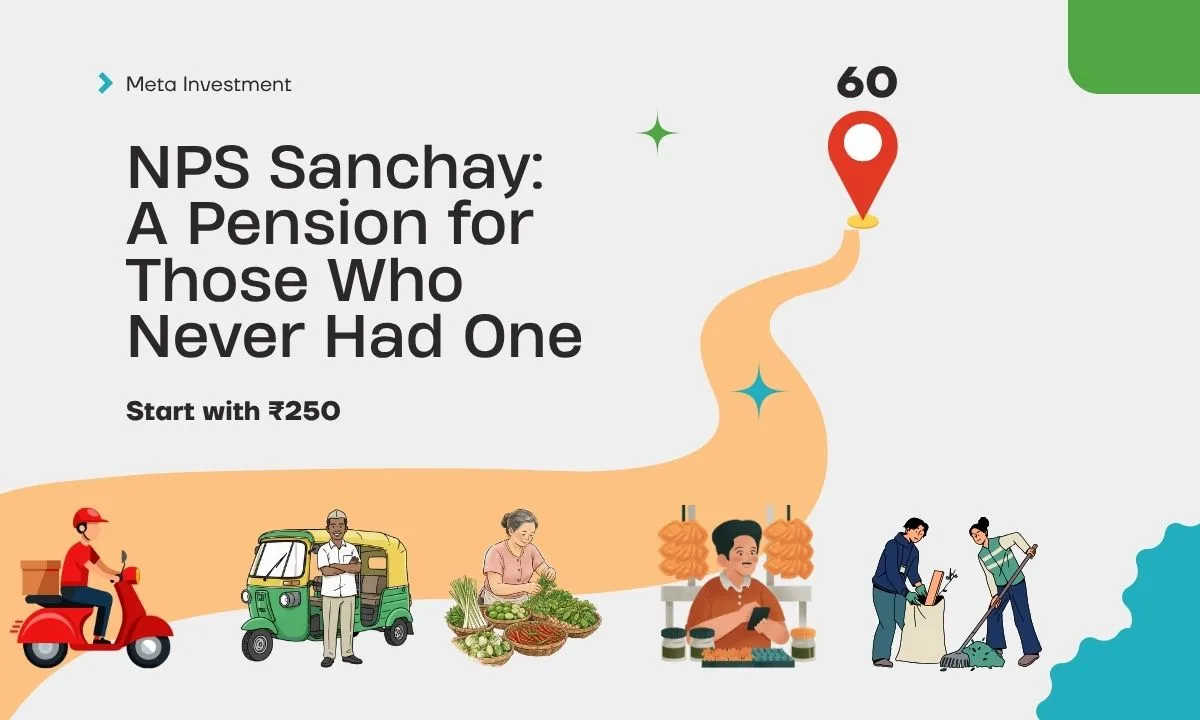
Think of the people who keep your household and neighbourhood running. The domestic helper who comes every morning. The driver. The vegetable vendor. The electrician you call on weekends. Your own parents, if they ran a small shop and never had a salaried job.
Most of them have no PF, no gratuity and no employer pension. When they stop working, the income stops too.
NPS Sanchay is PFRDA's attempt to make a pension account easy enough for them to actually open and keep. PFRDA introduced it in May 2026 and took it nationwide on NPS Diwas, October 1, 2026, with Pension Yatra camps that sign people up on the spot.
What Is NPS Sanchay?
NPS Sanchay is a simplified version of the National Pension System. It runs on the same NPS rails, under the same regulator, with the same withdrawal rules. What changes is how easy it is to start.
Three things make it simple:
- Tiny entry amount. ₹250 to open, then as little as ₹10 at a time.
- No yearly target. There is no fixed amount to deposit every year, so skipping a few months does not freeze the account.
- No investment decisions at the start. The money goes into a ready-made mix, so the subscriber does not face a screen full of choices like "equity", "corporate bonds" and "government securities".
NPS Sanchay at a Glance
| Question | Answer |
|---|---|
| Who runs it | PFRDA, under the NPS All Citizen Model |
| Who can join | Indian citizens aged 18 to 85, with KYC |
| Proof of informal work needed | No |
| First contribution | ₹250 |
| Later contributions | From ₹10 |
| Yearly minimum | None |
| How money is invested | Ready-made mix, about 75% bonds and 25% equity |
| Can the mix be changed | Yes, later, under NPS rules |
| Normal exit | After 15 years in NPS or at age 60, whichever is earlier |
| Lump sum at exit | Up to 80%; rest buys a pension (annuity) |
| Small corpus rule | Full withdrawal allowed if corpus is ₹8 lakh or less |
| Partial withdrawal before 60 | Up to 25% of own contributions, up to 4 times, for specified needs |
| Where to open | Online, banks, CSCs, Points of Presence, Pension Yatra camps |
Delivery, Ride or Freelance Partner? This Part Is for You
No PF. No gratuity. No company putting money into a pension for you. When the app stops sending orders, the income stops.
NPS Sanchay lets you build your own pension, a little at a time:
- Start with ₹250. After that, add ₹10, ₹50 or ₹100 whenever you can, even after a single shift, using UPI.
- Miss a month? That's fine. There is no fixed yearly amount, so the account does not shut down.
- No investment choices to make. The money is invested in a ready-made mix for you.
- What you need: Aadhaar or PAN, a bank account linked to your mobile, and 15 minutes.
Meta Investment is a registered NPS Point of Presence. If you want help opening an NPS Sanchay account, or just have a question, message us on WhatsApp with the word SANCHAY. We reply in Marathi, Hindi or English.
Prefer to read it in your own language first? See our simple guide to NPS Sanchay and small SIPs in Marathi or Hindi.
NPS is market-linked, so the value of your account can go up or down. Account opening and maintenance charges apply as per PFRDA rules. By messaging us, you agree to be contacted on WhatsApp about NPS.
Why Open an NPS Account at All?
Before getting into Sanchay, it helps to answer the bigger question: why a pension account, and not just a savings account or a few FDs?
1. Retirement money needs its own box. Money in a savings account gets used for festivals, school fees and repairs. NPS keeps retirement money separate, and the withdrawal rules make it hard to dip into casually. For someone without an employer pension, that discipline is the main benefit.
2. It turns savings into a monthly income. At exit, part of the corpus buys an annuity, which pays a regular pension. For an older person, a steady monthly amount is often easier to manage than a single lump sum.
3. Small amounts are enough to start. You do not need a big sum. ₹10 here and ₹100 there still goes into a regulated retirement account in your own name.
4. It is regulated and low-cost. NPS is supervised by PFRDA, money is managed by registered pension funds, and NPS charges are generally low compared to many other investment products.
5. The account goes with you. One PRAN (Permanent Retirement Account Number) stays with the person across jobs, cities and life changes.
NPS is market-linked. There is no fixed or promised return, and the value can go down as well as up.
How NPS Sanchay Is Different From Other NPS Options
PFRDA now offers several NPS routes. The easiest way to understand Sanchay is to see it next to them.
| NPS Sanchay | Regular NPS (All Citizen) | Atal Pension Yojana | NPS Vatsalya | NPS Swasthya | |
|---|---|---|---|---|---|
| Meant for | First-time savers, informal workers | Anyone who wants to choose | Low-income workers, non-taxpayers | Children under 18 | Saving for medical bills |
| Age to join | 18–85 | 18–85 | 18–40 | Under 18 (opened by parent) | As per NPS eligibility |
| Who decides investment mix | Pre-set for you | You choose | Not market-linked for the subscriber | Parent chooses | Pre-set |
| Pension amount | Depends on corpus | Depends on corpus | Fixed ₹1,000–₹5,000 a month | Depends on corpus | Not a pension product |
| Extra feature | Very low entry, assisted sign-up | Full flexibility | Fixed pension plan | Converts to regular NPS at 18 | Linked health insurance |
The real difference between Sanchay and regular NPS is who makes the investment choice.
In regular NPS, the subscriber picks a pension fund and decides the split between equity, corporate bonds and government bonds. Or they pick an age-based option where equity reduces as they grow older.
In Sanchay, that choice is made for them. About three-fourths goes into bonds and one-fourth into equity. The mix does not change automatically with age. It can be changed later if the subscriber wants.
Why does this matter? Because for many first-time savers, the choice screen is where they give up. A ready-made mix removes that hurdle.
The trade-off is that one mix is used for everyone. A 22-year-old gig worker and a 62-year-old shopkeeper start with the same split, even though their time to retirement is very different. Equity usually moves up and down more than bonds, but over long periods it behaves differently too. A bond-heavy mix is generally steadier, but it is also affected by changes in interest rates.
Neither approach is right for everyone. It depends on the person.
Who May Find NPS Sanchay Relevant
NPS Sanchay may be worth a look for people who:
- Have no employer pension, PF or gratuity, such as domestic helpers, drivers, cooks, security guards, delivery and ride-hailing partners, small shopkeepers, artisans and farmers.
- Earn irregular income and can save only small amounts, when they can.
- Are saving for the first time and find investment choices confusing.
- Are older (the entry age goes up to 85) and want a simple, regulated place for some savings.
- Are self-employed or homemakers without a retirement account of their own.
It may be less relevant for someone who:
- Already has a regular NPS account with an investment mix they chose.
- Is a salaried professional who wants to set their own equity share, or wants an age-based option.
- Is looking for a fixed pension amount, which is what Atal Pension Yojana offers to those eligible.
For many readers of this blog, the more useful question is not "should I open Sanchay?" but "is there someone in my life who should know about it?" A parent, a long-time helper, or a relative running a small business may be the person it was designed for.
The suitability of any investment category depends on an investor's financial goals, risk appetite, investment horizon and overall financial circumstances. This post is for educational purposes only and is not a recommendation to open, or avoid, an NPS Sanchay account.
How to Open an NPS Sanchay Account
- Keep documents ready: Aadhaar or PAN for KYC, and an active bank account.
- Choose a channel: the online NPS platform, a bank or other Point of Presence, a Common Service Centre, or an NPS Sanchay Pension Yatra camp.
- Complete KYC and select NPS Sanchay.
- Make the first contribution of ₹250.
- Note the PRAN you receive. Later contributions, from ₹10, are linked to it.
From October 1, 2026, a one-time onboarding fee of ₹200 per account applies when registering through a Point of Presence. Regular NPS account charges also apply.
Before You Open, Check These
- Withdrawal rules: money is meant to stay until 60 or 15 years, with limited partial withdrawals.
- Investment mix: whether a mostly-bond mix fits the person's age and comfort with ups and downs.
- Changing the mix later: how many changes NPS rules allow each year.
- Charges: the onboarding fee and ongoing account charges.
- Tax: the circular does not cover tax. Many informal workers do not pay income tax, and for those who do, a qualified tax professional can confirm the treatment.
Key Takeaways
- NPS Sanchay is a simplified NPS account you can open with ₹250 and top up with ₹10.
- Any Indian citizen aged 18 to 85 with KYC can join; no proof of informal work is needed.
- The investment mix, about 75% bonds and 25% equity, is set for you and can be changed later.
- The main difference from regular NPS is that you do not have to make the investment choice.
- Exit and withdrawal follow normal NPS rules: 15 years or age 60, up to 80% lump sum.
A Pension for People Who Never Had One
Most salaried professionals get a retirement account through their employer without thinking about it. Most of India's workforce does not. NPS Sanchay lowers the bar to entry: small amounts, no hard choices, and help with sign-up.
Whether it fits a particular person still depends on their age, income and other savings. If you are thinking about how this, or regular NPS, could fit your own plan or a family member's, that is a conversation worth having.
If investments are made through a mutual fund distributor, the distributor may receive commissions from Asset Management Companies. Such commissions should not influence suitability-based recommendations. Mutual Fund investments are subject to market risks. Please read all scheme-related documents carefully before investing.
Interested in Investing? Connect with Meta Investment
Meta Investment is a financial product distribution and services firm. If you'd like to explore whether a financial product is the right fit for your portfolio, our team will walk you through the details, help you assess suitability, and guide you through the onboarding process.
Meta Investment – Your Investment and Insurance Companion
Frequently Asked Questions
What is NPS Sanchay in simple words?
NPS Sanchay is a simpler way to open a National Pension System account. You can start with ₹250 and add as little as ₹10 at a time. You do not have to choose how your money is invested; a ready-made mix of mostly bonds and some shares is applied for you. It was introduced by PFRDA in 2026 for people who have no pension through an employer.
Who can open an NPS Sanchay account?
Any Indian citizen aged 18 to 85 who completes KYC can open an NPS Sanchay account. The scheme is designed for informal sector workers such as domestic helpers, drivers, shopkeepers, gig workers and farmers, but the eligibility rule itself does not ask for proof of occupation or income.
Do I need to prove that I work in the informal sector to open NPS Sanchay?
No. PFRDA's circular sets only two conditions: Indian citizenship and age between 18 and 85, along with KYC. There is no occupation proof, income test or self-declaration about the informal sector. The informal sector is the group the scheme is designed for, not a condition for joining.
What is the minimum amount to open NPS Sanchay?
The first contribution is ₹250 and every later contribution can be as low as ₹10. There is no fixed amount you must put in every year, so the account does not get frozen for skipping a year. Charges for opening and maintaining the account apply separately.
How is NPS Sanchay money invested?
NPS Sanchay follows the investment pattern used for government employees' NPS schemes. Launch information describes it as about 75% in government securities and corporate bonds and about 25% in equity. The subscriber does not need to choose this; it is applied by default, and PFRDA may revise the pattern over time.
Can I change the investment mix in NPS Sanchay later?
Yes. Subscribers can change their pension fund and asset allocation later, following the rules that apply to the NPS All Citizen Model. Those rules limit how many times such changes can be made in a financial year.
How is NPS Sanchay different from regular NPS?
In regular NPS, you choose a pension fund and decide how much goes into equity, corporate bonds and government bonds, or pick an age-based option. In NPS Sanchay, a fixed, mostly-debt mix is applied for you, the entry amount is very low, and assisted sign-up is available at CSCs and outreach camps. The withdrawal and exit rules are those of NPS.
What is the difference between NPS Sanchay and Atal Pension Yojana?
Atal Pension Yojana is for people aged 18 to 40 who are not income-tax payers. It pays a fixed monthly pension of ₹1,000 to ₹5,000 from age 60, depending on the contribution plan chosen. NPS Sanchay is open from 18 to 85, has no fixed pension amount, and the final value depends on how the invested money performs.
When can I withdraw money from NPS Sanchay?
Normal exit is allowed after 15 years in NPS or at age 60, whichever comes first. At that point up to 80% of the corpus can be taken as a lump sum and the rest goes into an annuity that pays a pension. If the total corpus is ₹8 lakh or less, the full amount can be withdrawn.
Can I take money out of NPS Sanchay before 60 in an emergency?
Partial withdrawal of up to 25% of your own contributions is allowed for specified needs such as illness, children's education or marriage, or buying a house. Up to four partial withdrawals can be made before age 60. The current PFRDA exit and withdrawal regulations are the final reference.
Why should someone without an employer pension open an NPS account?
Without an employer pension, retirement money has to be built by the person alone. NPS gives a regulated, low-cost account that keeps this money separate from day-to-day spending, makes early withdrawal difficult, and turns part of the savings into a monthly pension at retirement. Whether it fits depends on the person's income, goals and other savings.
Is NPS Sanchay safe?
NPS is regulated by PFRDA, and the money is managed by registered pension funds and held in the subscriber's own account. However, NPS is market-linked, so the value can go up or down, and there is no promised return. NPS Sanchay has a smaller equity share than many other NPS options, which usually means smaller swings but does not remove market risk.
What is NPS Tatkal?
NPS Tatkal is a quick sign-up route that uses existing bank KYC and UPI to open an NPS account on the spot. It is being used at NPS Sanchay Pension Yatra camps to enrol workers who may not visit a bank branch. It is a way to open an account, not a separate scheme.
Is NPS Sanchay the same as NPS Swasthya?
No. NPS Swasthya is a separate scheme that combines an NPS account with a compulsory super top-up health insurance policy for medical expenses. NPS Sanchay is a simple retirement savings account with no insurance part.
Do NPS Sanchay contributions get a tax deduction?
PFRDA's circular does not mention tax. NPS contributions under the All Citizen Model have generally qualified under Section 80CCD(1) and the extra Section 80CCD(1B) limit in the old tax regime. Many informal workers may not pay income tax at all. A qualified tax professional is the right person to confirm individual treatment.


Mutual fund updates, SIP tips, and what's moving the market. No daily noise — only when there's something worth reading.
Read more about
- How to Prepare Retirement Plan
- Lucrative Investment Opportunities Options for NRIs in India
- Happy Women's Day 2024
- Ensuring Retirement Bliss: Key Factors to Assess Retirement Income Sufficiency
- A Look Back at 10 Years of Performance of Equity schemes of NPS
- जुनं फर्निचर Juna Furniture (Old Furniture): A Stark Reminder of the Importance of Retirement Planning
- Demystifying Annuities: Your Retirement Income Lifeline?
- Secure Your Golden Years: A Guide to Corporate NPS for Employees
- Boost Your Retirement Savings with Enhanced NPS Benefits in Budget 2024
- Unified Pension Scheme (UPS) vs NPS: Which is better for your retirement?
- NPS Vatsalya launched today
- Building Blocks of Wealth: A Guide to Investing for Kids
- Building Your Layer Cake
- MOIC: A Comprehensive Guide
- Key Union Budget Announcements - 2025
- 7-Day Plan for Indian Women to Kickstart Their Financial Journey: From Scarcity to Abundance
- Unified Pension Scheme (UPS) for Government Employees: A Complete Guide
- Common Myths About Corporate NPS Debunked
- ManipalCigna Sarvah Uttam Health Insurance Plan: Comprehensive Coverage with Unique Benefits
- Mutual Funds Are the New Status Symbol (Not Your Bank Balance)
- Mutual Fund Scheme Name Changes in India (2025) – Complete List & Reasons
- From Freedom Fighters to Financial Freedom: Gen Z Investing & Independence Day Lessons
- All Weather Gold: A Principal-Protected Way to Bet on Gold (Until Aug 31)
- ESAF SFB NCD Issue: 11.30% Coupon | Basel II Compliant Bonds
- Begin Your Wealth Journey This Ganesh Chaturthi: Ganpati-Inspired Mutual Fund Lessons
- Tata AIA Health SIP Review 2025: A Smart Health + Investment Plan?
- NPCI Raises UPI Transaction Limits: A Complete Guide to High-Value Payments from Sept 2025
- NPS Exit Rules 2025: Your Guide to the Major Changes for Withdrawal, Annuity & More
- New NPS Exit Rules 2025: Higher Lump Sum, No Lock-in & Flexible Withdrawals
- NPS Retirement Income Schemes (RIS) & Drawdown Options Explained
- EPS 2026: What the New Employees' Pension Scheme Means for You
- NPS Swasthya Explained: Wait for the Health-Linked Pension, or Buy Health Cover Now?
- AMFI Stock Reclassification: What It Means for Your Fund
- FTSE India Index Explained: What It Is & Why It Matters Now
- Tata Mumbai Marathon 2027 Fee Is ₹5,000: How to Budget for It
- Pune on India's Wealth Map: What the 2026 List Reveals
- Emergency Fund: The Money That Buys the Right to Say No
- The 8 Freedoms Checklist for Financial Independence
- How to Check an Insurer's Complaint Record Before You Buy
- Your Increment Came Through. Did Your SIP?
- PFRDA's New NPS Scheme Categories: What Actually Changed
- SEBI Mandatory Nomination Rules for Demat and MF Folios
- Financial Green Flags That Matter More Than Salary
- Record SIP Inflows in a Falling Month: Reading August's AMFI Data
- NPS Swasthya Guidelines 2026: What PFRDA Just Changed
- Navratri to Diwali 2026: Your Festive-Season Money Calendar
- महिलांसाठी आर्थिक यशस्वीतेची 7-दिवसीय नियोजन: टंचाईपासून विपुलतेकडे
- सरकारी कर्मचाऱ्यांसाठी एकीकृत पेन्शन योजना (यूपीएस): एक संपूर्ण मार्गदर्शक
- कॉर्पोरेट एनपीएस बद्दलच्या गैरसमजांचे खंडन
- एप्रिल २०२५ पासून भारतातील म्युच्युअल फंड स्कीमच्या नावातील बदल - संपूर्ण यादी आणि कारणे
- Demat आणि MF Folio साठी SEBI चे अनिवार्य Nomination नियम
- पगारापेक्षा जास्त महत्त्वाची असणारी आर्थिक हिरवी निशाणे
- NPS Swasthya मार्गदर्शक तत्त्वे 2026: PFRDA ने नेमके काय बदलले
- नवरात्री ते दिवाळी 2026: सणासुदीच्या काळातील आर्थिक दिनदर्शिका
- NPS Sanchay सोप्या भाषेत: कोणासाठी आणि इतर NPS पेक्षा वेगळे कसे
Related Posts
This communication is intended solely for general educational and informational purposes. The information provided is general in nature and does not take into account the specific financial goals, risk profile, investment horizon, financial circumstances or other requirements of any particular investor. It should not be construed as personalised investment advice or as a recommendation to buy, sell or hold any specific financial product.
NPS is a defined-contribution retirement product regulated by PFRDA; investment outcomes depend on the selected investment option and market performance, and applicable exit/withdrawal conditions should be reviewed.
Distributor Disclosure: Where this content is provided by a distributor/intermediary, any applicable commission, remuneration, affiliation or other material conflict of interest shall be disclosed separately. The availability of a product through the distributor does not by itself imply that the product is suitable for every investor.
No Guarantee: No statement on this page should be interpreted as a promise, assurance or guarantee of returns or investment outcomes.
Meta Investment – Your Investment and Insurance Companion