

AMFI Stock Reclassification: What It Means for Your Fund

Twice a year, a spreadsheet published by AMFI quietly redraws the boundary between “large cap”, “mid cap” and “small cap” — and mutual fund portfolios across India adjust to it. The latest list applies from 1 August 2026.
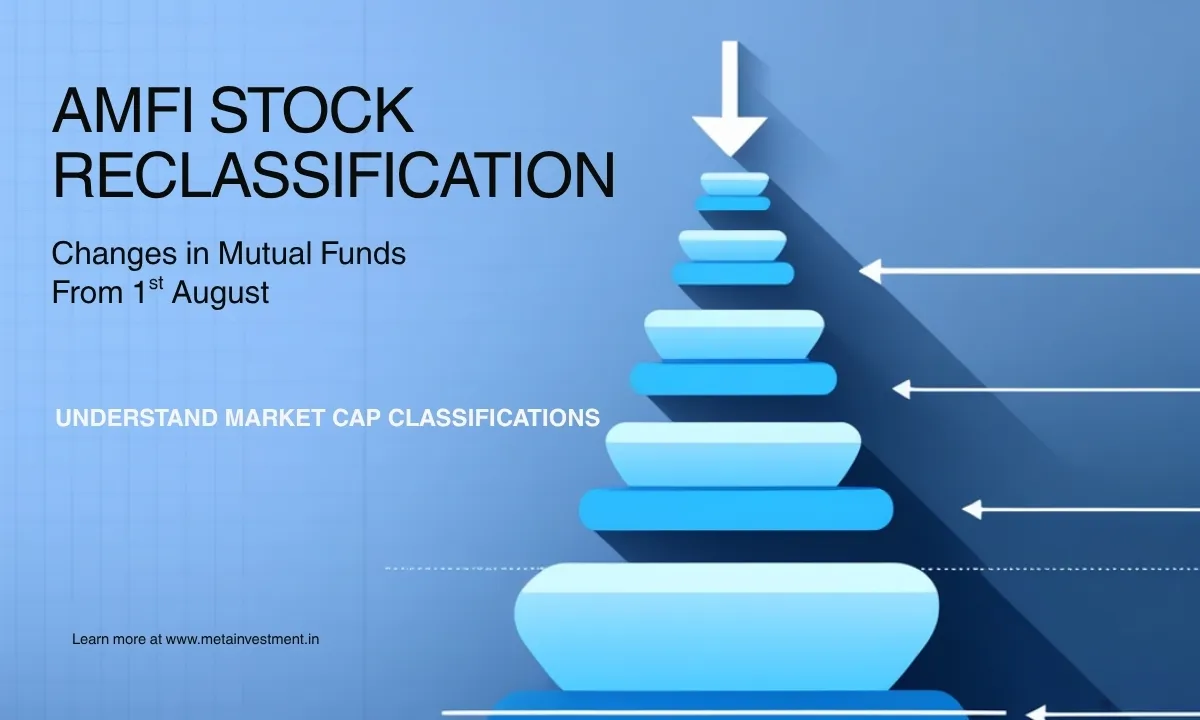
Most investors never see this document. Yet it decides whether the fund labelled “large cap” in your portfolio is allowed to keep holding a particular company, and it explains why some well-known names see unusual trading activity in the weeks around the changeover. This post explains the mechanism in plain language — what the list is, why funds must act on it, and what it does (and does not) mean for an SIP you already have running.
What the AMFI list actually is
Before 2017, one fund house’s “large cap” could be another’s “mid cap”. SEBI’s scheme categorisation framework ended that ambiguity by mandating a single, industry-wide definition — and handed the arithmetic to AMFI.
The method is deliberately mechanical:
- Every listed company is ranked by its average full market capitalisation over the preceding six months, across exchanges.
- Ranks 1–100 are classified as large cap.
- Ranks 101–250 are classified as mid cap.
- Rank 251 onwards are classified as small cap.
The list is refreshed twice a year. The January edition uses July–December data; the July edition uses January–June data. Crucially, it uses full market capitalisation (not free float) and a six-month daily average (not a month-end snapshot), which smooths out one-off price spikes.
The July 2026 edition
The current round is based on average market capitalisation for January to June 2026 and becomes effective from 1 August 2026, remaining the reference list for roughly the next six months.
| Threshold | January 2026 list | July 2026 list |
|---|---|---|
| Large cap cutoff (rank 100) | ~₹1,05,000 crore | ~₹1,06,300 crore |
| Mid cap cutoff (rank 250) | ~₹34,700 crore | ~₹33,500 crore |
| Total stocks in AMFI universe | 5,372 | 5,427 |
Two details are worth pausing on. First, the large cap threshold rose while the mid cap threshold fell — a reminder that the cutoffs move with the market, not with any company’s individual performance. Second, average market capitalisation actually eased across all three segments even as the large cap cutoff went up, partly reflecting an expanding universe of listed companies.
A stock can be downgraded in a period when its own share price went up. Because the boundary is a rank, not an absolute number, a company simply needs others to move faster.
Which companies changed bucket
Around thirty-five companies shifted category in this round. The names below are listed purely as factual illustrations of how the classification arithmetic played out — they are not a comment on any company’s business, valuation or prospects, and nothing here is a view on any security.
| Movement | Companies |
|---|---|
| Mid cap → Large cap (8) | BSE, Vodafone Idea, Hitachi Energy India, Jindal Steel, Indian Bank, Indus Towers, Billionbrains Garage Ventures (Groww), BHEL |
| New entrant to Large cap (1) | Vedanta Aluminium Metal |
| Large cap → Mid cap (9) | Bosch, Siemens Energy India, Hero MotoCorp, Dr. Reddy’s Laboratories, LG Electronics India, Max Healthcare Institute, Mazagon Dock Shipbuilders, Indian Hotels, Lodha Developers |
| Small cap → Mid cap (6) | Hindustan Copper, NLC India, AIA Engineering, Ajanta Pharma, Aster DM Healthcare, Sona BLW Precision Forgings |
| New entrants to Mid cap (3) | Knowledge Realty Trust, Embassy Office Parks REIT, Bagmane Prime Office REIT |
| Mid cap → Small cap (10) | Tata Investment Corporation, Hexaware Technologies, K.P.R. Mill, Jubilant FoodWorks, CRISIL, Global Health (Medanta), Physicswallah, Cholamandalam Financial Holdings, SJVN, Kaynes Technology India |
The most instructive detail in the whole list
Look closely and something odd emerges. Bosch and Hero MotoCorp were both upgraded from mid cap to large cap in the January 2026 list — and both have now been downgraded back to mid cap six months later. Indus Towers did the reverse: downgraded in January, upgraded in July. And AIA Engineering, Ajanta Pharma, NLC India and Sona BLW Precision Forgings were all moved from mid cap to small cap in January, only to move back up to mid cap now.
These are not companies whose businesses transformed twice in twelve months. They are companies sitting close to a boundary line — and a rank-based boundary, recalculated every six months, will inevitably shuffle whoever happens to be standing near it. Roughly a third of the names on any given change list are boundary cases of this kind.
This is the single best argument for treating reclassification as administrative noise rather than information. If a category change genuinely carried a signal about business quality, the same handful of companies would not keep crossing back and forth.
Why your fund has to do something about it
This is where the list stops being trivia and starts touching portfolios. SEBI’s categorisation framework attaches minimum allocation floors to cap-based equity categories:
| Scheme category | Mandated minimum allocation |
|---|---|
| Large Cap Fund | At least 80% in large cap stocks |
| Mid Cap Fund | At least 65% in mid cap stocks |
| Small Cap Fund | At least 65% in small cap stocks |
| Large & Mid Cap Fund | At least 35% each in large and mid cap stocks |
| Multi Cap Fund | At least 25% each in large, mid and small cap stocks |
| Flexi Cap Fund | At least 65% in equity, with no cap-wise floor |
Now consider a large cap fund holding a stock at rank 98. On 31 July it counts towards the 80% floor. On 1 August, after slipping to rank 104, the same holding no longer counts — even though the fund manager bought nothing, sold nothing, and formed no new view. The scheme’s compliance arithmetic changed underneath it.
That is a passive breach: a deviation caused by an external event rather than by the AMC’s action. The regulatory machinery for handling it is straightforward. AMFI’s best-practice guidelines allow roughly one month from the effective date to realign, and SEBI’s 2022 rebalancing circular permits 30 business days to correct passive breaches of mandated allocation, extendable to 60 business days with written justification recorded before the investment committee. Where schemes fail to rebalance within the extended window, SEBI’s framework restricts new scheme launches and the levying of exit loads on investors exiting.
The flow effect — and why it is technical
If many schemes must reduce exposure to the same downgraded stock within a similar window, that creates concentrated selling pressure. If several must add an upgraded stock, the reverse happens. Fund houses generally do not wait for the deadline; positioning often begins ahead of the effective date, which is why affected names sometimes see activity in late June and late December.
The important point for an investor: this is a liquidity and mandate event, not a verdict on the business. A company’s profitability, order book and governance are exactly what they were the day before the list changed.
What it means for an existing SIP
For most retail investors, the honest answer is: less than the headlines suggest.
Nothing changes operationally. Your SIP mandate, instalment amount, debit date, folio and KYC are untouched. There is nothing to re-register, pause or restart. Future instalments continue buying units of the same scheme.
What changes is the underlying mix. The scheme you own may look slightly different a month from now — same mandate, same manager, marginally different constituents. In a large cap fund, that typically means a few substitutions at the boundary of the top-100 universe, not a portfolio overhaul.
Turnover carries a cost. Rebalancing involves brokerage, securities transaction tax and market impact, borne within the scheme. This is one input into the scheme’s turnover ratio, which investors may review alongside the expense ratio in the factsheet and scheme documents.
There is no tax event for you. Transactions inside a scheme’s portfolio do not create a tax liability for unitholders. Capital gains arise only when you redeem or switch your own units. Tax treatment varies by scheme type and holding period, and a qualified tax advisor may be consulted for individual circumstances.
Which categories feel it most
Not all equity funds experience this the same way.
- Most affected: Large cap, mid cap, small cap and large & mid cap funds — each carries a hard floor tied directly to the AMFI buckets.
- Moderately affected: Multi cap funds, with 25% minimums in each of the three segments.
- Least constrained: Flexi cap funds, which need only 65% in equity with no cap-wise obligation. Reclassification changes how their holdings are described more than what they are required to do.
- A separate calendar altogether: Index funds and ETFs track benchmark indices whose constituents are reviewed by the index provider (NSE Indices, BSE) on its own schedule. That review is independent of the AMFI list, even though the two exercises can look similar from the outside.
The suitability of any of these categories depends on an investor’s financial goals, risk appetite, investment horizon and overall financial circumstances — not on which stocks happened to move buckets this cycle.
Three misreadings worth avoiding
“An upgrade means the stock is better.” It means the company’s six-month average market capitalisation rose relative to peers. Size ranking is not a quality, valuation or prospects assessment.
“My mid cap fund will now hold different-sized companies.” The fund’s mandate is unchanged. What shifted is the boundary line — and boundaries move every six months by design.
“I should switch funds before the rebalancing.” Attempting to trade around a scheduled, publicly known administrative event assumes an information edge that a published calendar does not provide. Investors may review their asset allocation in line with their goals and risk profile rather than reacting to a date.
Key takeaways
- AMFI’s list, published each January and July, is the single industry-wide definition of large, mid and small cap, based on six-month average full market capitalisation.
- The current edition takes effect from 1 August 2026; the large cap cutoff edged up while the mid cap cutoff eased.
- SEBI’s minimum allocation floors — 80% for large cap funds, 65% for mid and small cap funds — are why a stock’s reclassification can force scheme-level realignment.
- Fund houses have roughly a month from the effective date under AMFI best practice, with SEBI allowing 30 business days for passive breaches, extendable to 60.
- For an existing SIP, nothing operational changes. The underlying holdings adjust; the mandate, the folio and the instalment do not.
- Category shifts are technical and mechanical. They are not signals about company fundamentals, and they are not signals about scheme quality.
The bigger picture
The reclassification exercise exists for a reason that benefits investors: it keeps schemes true-to-label. When you buy a large cap fund, you want reasonable confidence that it holds large cap companies as consistently defined across the industry — not as one AMC’s marketing team chooses to define them. The twice-yearly churn is the cost of that consistency, and it is a cost worth understanding rather than fearing.
A useful habit, for those who want one: pull up your scheme’s monthly factsheet a month or two after the effective date and look at the cap-wise break-up. It is a five-minute exercise that turns an abstract regulatory event into something you can actually see in your own portfolio.
Interested in Investing? Connect with Meta Investment
Meta Investment is a financial product distribution and services firm. If you'd like to explore whether a financial product is the right fit for your portfolio, our team will walk you through the details, help you assess suitability, and guide you through the onboarding process.
Mutual Fund investments are subject to market risks. Please read all scheme-related documents carefully before investing. Past performance may or may not be sustained in the future.
The suitability of any investment category depends on an investor’s financial goals, risk appetite, investment horizon and overall financial circumstances. This communication is intended solely for educational and informational purposes and should not be construed as investment advice, a recommendation, or a solicitation to buy or sell any financial product.
If investments are made through a mutual fund distributor, the distributor may receive commissions from Asset Management Companies. Such commissions should not influence suitability-based recommendations.
Company names in this article are referenced solely as factual illustrations of AMFI’s market-capitalisation classification and do not constitute a recommendation, a view on any security, or an assessment of any company’s business, valuation or prospects. Meta Investment does not provide stock recommendations. Classification details and cutoff figures are compiled from published market commentary on the July 2026 categorisation; the list and methodology published by AMFI on amfiindia.com remain the authoritative reference and readers may verify against it. Tax treatment depends on individual circumstances and prevailing law — please consult a qualified tax advisor.
Meta Investment – Your Investment and Insurance Companion.
Frequently Asked Questions
What is AMFI's biannual stock reclassification?
It is a half-yearly exercise in which the Association of Mutual Funds in India publishes an official list classifying listed companies as large cap, mid cap or small cap. The classification is based on each stock's average full market capitalisation over the preceding six months. The list is published in the first week of January and July, and mutual fund schemes use it as the common reference for their category mandates.
How does AMFI decide which stocks are large cap, mid cap and small cap?
Following the SEBI scheme categorisation framework, companies are ranked by six-month average full market capitalisation across exchanges. The top 100 companies are classified as large cap, the next 150 (ranks 101 to 250) as mid cap, and every company ranked 251 and below as small cap. The ranking is mechanical — it is a size ranking, not a quality or performance ranking.
When does the July 2026 AMFI list take effect?
The list released in the first week of July 2026 is based on average market capitalisation for January to June 2026 and takes effect from 1 August 2026. It remains the reference list until the next revision, which would ordinarily apply from February 2027.
Why do mutual funds have to rebalance when a stock changes category?
SEBI's categorisation framework prescribes minimum allocation floors for cap-based schemes — for example, a large cap fund must hold at least 80% of assets in large cap stocks, and mid cap and small cap funds at least 65% in their respective segments. When AMFI moves a stock between buckets, a scheme's compliance position can change overnight even though the fund manager did nothing, so the portfolio may need realigning.
How much time do fund houses get to rebalance after the AMFI list changes?
Industry practice under AMFI's best-practice guidelines allows roughly one month from the effective date of the new list to realign portfolios. Separately, SEBI's 2022 rebalancing circular gives schemes 30 business days to correct passive breaches of mandated asset allocation, extendable up to 60 business days with documented justification placed before the investment committee.
Does AMFI reclassification affect my running SIP?
Your SIP mandate, instalment amount, date and folio are unaffected — nothing needs to be changed, restarted or re-registered. What changes is the underlying universe your scheme draws from. Future instalments buy units of the same scheme, which may now hold a slightly different mix of stocks after the fund house completes its realignment.
Is it good news if a stock in my fund gets upgraded to large cap?
An upgrade only confirms that the company's six-month average market capitalisation has risen relative to other listed companies. It is a size classification, not an assessment of business quality, valuation or future prospects. Upgrades and downgrades can both be accompanied by short-term buying or selling flows from schemes realigning their portfolios, and these technical flows are separate from company fundamentals.
Which mutual fund categories are most affected by reclassification?
Cap-constrained categories feel it most — large cap, mid cap, small cap and large & mid cap funds all carry minimum allocation floors tied to the AMFI buckets. Flexi cap funds, which need only 65% in equity with no cap-wise floor, have far more latitude. Index funds and ETFs follow their benchmark index's own review calendar, which is set by the index provider and is separate from the AMFI list.
Do multi cap and flexi cap funds react differently to the AMFI list?
Yes. A multi cap fund must hold a minimum of 25% each in large, mid and small cap stocks, so it is directly bound by the AMFI buckets. A flexi cap fund has no cap-wise minimum and can shift freely across market capitalisations, so reclassification changes its labelling arithmetic more than its actual obligations.
Will reclassification change my fund's NAV?
The classification event itself does not change the NAV. NAV reflects the market value of the underlying holdings. However, if several schemes buy or sell the same reclassified stock within a similar window, that stock's price can see short-term movement driven by flows rather than fundamentals, and this can indirectly affect the NAV of funds holding it.
Are there costs to investors when a fund rebalances?
Portfolio churn carries transaction costs — brokerage, securities transaction tax and market impact — which are borne within the scheme and reflected in returns. Reclassification-driven turnover is one input into a scheme's overall turnover ratio, which investors may review alongside the expense ratio in the scheme documents and factsheets.
Do I have to pay tax when my fund rebalances its portfolio?
No. Buying and selling within a scheme's portfolio does not create a tax event for the unitholder. Capital gains tax applies to you only when you redeem or switch your own units. Tax treatment depends on the scheme type and holding period, and individual tax positions vary, so a qualified tax advisor may be consulted.
Should I switch funds because of the AMFI reclassification?
Reclassification is a routine, scheduled administrative event rather than a signal about any scheme. The suitability of any investment category depends on an investor's financial goals, risk appetite, investment horizon and overall financial circumstances. Investors may review their asset allocation with their mutual fund distributor or financial adviser rather than reacting to a calendar event.
Which stocks changed category in the July 2026 AMFI reclassification?
Around thirty-five companies shifted bucket. Eight moved from mid cap to large cap — BSE, Vodafone Idea, Hitachi Energy India, Jindal Steel, Indian Bank, Indus Towers, Billionbrains Garage Ventures (Groww) and BHEL — with Vedanta Aluminium Metal entering the large cap bucket as a new inclusion. Nine moved from large cap to mid cap, including Bosch, Siemens Energy India, Hero MotoCorp, Dr. Reddy's Laboratories, LG Electronics India, Max Healthcare Institute, Mazagon Dock Shipbuilders, Indian Hotels and Lodha Developers. Six moved from small cap to mid cap and ten from mid cap to small cap. These are stated as factual classification changes and are not a view on any security.
Why do the same companies keep moving between categories?
Because the classification is a rank-based boundary recalculated every six months, companies sitting close to rank 100 or rank 250 tend to shuffle repeatedly. Bosch and Hero MotoCorp were upgraded to large cap in January 2026 and moved back to mid cap in July 2026; Indus Towers did the opposite. AIA Engineering, Ajanta Pharma, NLC India and Sona BLW Precision Forgings moved down to small cap in January and back up to mid cap in July. This pattern illustrates that a category change reflects relative position near a boundary rather than any transformation in the underlying business.
Where can I check the official AMFI classification list?
The official list and its methodology are published on AMFI's website (amfiindia.com) under its stock categorisation disclosures. Secondary media summaries can differ in detail, so the AMFI file is the authoritative reference for the applicable cutoffs and stock-wise classification.
How can I tell whether my fund is still true-to-label after the change?
Monthly portfolio disclosures and scheme factsheets published by the AMC show the cap-wise break-up of holdings. Reviewing the factsheet a month or two after the effective date shows how the scheme's allocation looks against the new list. Scheme information documents also state the mandated allocation range for the category.

Mutual fund updates, SIP tips, and what's moving the market. No daily noise — only when there's something worth reading.
Read more about
- Arudha SIF offered by Bandhan Mutual Fund
- Meta Investment | AMFI-Registered Mutual Fund Distributor | SIP & Financial Planning India
- Assets Under Management (AUM) in Mutual Funds – What Investors Must Know
- Aashadhi Ekadashi: Begin Your Journey to True Financial Samruddhi
- Beginner’s Guide to Mutual Funds in India – How to Start Investing in 2026
- Debt Mutual Funds – A Comprehensive Guide
- Diviniti SIF offered by ITI Mutual Fund
- Diwali Investment Myths vs Reality: Insights for Pune’s Urban Investors
- Unlocking Wealth: The Comprehensive Guide to ELSS Mutual Funds
- Equity Mutual Funds - Types, Benefits & SEBI Categories (2025)
- Exchange-Traded Funds (ETFs) in India and Globally: A Complete Guide
- Mutual Fund FAQ's
- Demystifying FATCA: A Crucial Aspect of Mutual Fund Investments in India
- What are Floating Rate Funds? Meaning, Working, Risk & Performance Explained for Indian Investors
- Focused Mutual Fund: Concentrated Investing for Potential Growth
- Gold and Silver ETFs & Index Mutual Funds in India - Benefits, Risks & How to Invest
- How to Choose the Right SIP Plan for Your Financial Goals | Smart SIP Investing in India
- How to Start Your First ₹100 SIP (Chhoti SIP): Step-by-Step Guide (2026)
- How to Start Your First ₹1,000 SIP: Step-by-Step Guide for Beginners (2026)
- How to Start Your First ₹500 SIP: A Complete Beginner's Guide (2026)
- How to Start Your First ₹5,000 SIP: Complete Step-by-Step Guide (2026)
- Hybrid Mutual Fund
- Index Mutual Funds: Smart, Cost-Effective Investing for Indian Investors
- Mutual Fund Distributor & Financial Planner in Pune
- Mutual Fund, NPS & Financial Planning Services in Baner, Pune
- Mutual Fund & Financial Planning Services in Sambhaji Nagar, Pimpri Chinchwad
- Mutual Fund & Financial Planning Services in Pimpri Chinchwad, Pune
- Mutual Fund & Financial Planning Services in Chinchwad, Pune
- Mutual Fund & Financial Planning Services in Wakad, Pune
- Mutual Fund & Financial Planning Services in Hingewadi, Pune
- Mutual Fund & Financial Planning Services in Balewadi, Pune
- Mutual Fund Distributor & Financial Planner in Pimple Saudagar, Pune
- Mutual Fund & Financial Planning Services in Rahatani, Pune
- Introduction to Specialized Investment Funds (SIFs)
- Investment Strategies in Specialized Investment Funds (SIFs)
- ISID (Investment Strategy Information Document) for SIFs: SEBI Guidelines & Investor Guide
- iSIF SIF offered by ICICI Prudential Mutual Fund
- ISIN
- Liquid Mutual Funds: A Simple Guide for Indian Investors
- Mutual Fund Categorization and Types of Schemes: A Comprehensive Guide
- Mutual Fund History
- Mutual Funds in India 2026: Types, SIP Returns & Guide
- Understanding the NAV of Mutual Funds in India
- Mutual Fund Nominee in India (2026): Why You Need One & How to Add It
- Diwali 2025 Investment Offers - Available Now
- iSIF One-Pager
- qsif SIF offered by Quant Mutual Fund
- Leading Specialized Investment Fund Houses in India
- SIF vs Mutual Fund vs PMS vs AIF: Key Differences, Benefits & Comparison Table
- Specialized Investment Funds (SIFs)
- What is SIP in Mutual Funds? Benefits, How It Works (2026).
- SIP vs SIF: How Are They Different? (2026 Guide)
- Systematic Transfer Plan (STP) in Mutual Funds: A Smart Investment Strategy for India
- Understanding the difference between IDCW and SWP in Mutual Funds
- Surviving the Tech Slowdown: Financial Rebalancing in a No-Hike Year
- Thank you for registering!
- Top 5 Diwali Investment Gifts for Your Loved Ones in Pimple Saudagar
- Total Expense Ratio (TER) in Mutual Funds
- The Wealth Waari: Lessons in Discipline from a Timeless Journey
- Ye Diwali Goal SIP Wali