
US Fed Holds Rates: What It Means for Gold, Silver & the Rupee
The US Federal Reserve kept interest rates unchanged in July 2026, but the vote was the most divided in years. Here is what that means for gold, silver and the rupee, explained in plain language.
For Indian investors, a meeting in Washington can feel very far away. Yet the price of the gold in your locker, the exchange rate on your child's overseas tuition fee, and the yield on the debt fund in your portfolio all carry some fingerprint of what the US Federal Reserve decides. This post walks through the July 2026 decision, what other major central banks have done in recent weeks, and the channels through which these events reach Indian households.
What the Fed Actually Decided
The Federal Open Market Committee (FOMC) concluded its two-day meeting on 29 July 2026. The Committee voted 9-3 to leave the federal funds rate in a range of 3.50% to 3.75%, with all three dissenting votes coming from regional Federal Reserve Bank presidents who wanted an increase. This marked the fifth consecutive meeting at which the rate was left unchanged.
The post-meeting statement was almost identical to the June one and, in keeping with Chair Kevin Warsh's preference for shorter communication, was notably brief. Inflation remains above the central bank's 2% target, and the decision came against the backdrop of continued conflict involving the US and Iran. Crude prices had been volatile, rising more than 20% over the course of July, which tends to keep headline inflation readings elevated in the near term.
The next FOMC meeting is scheduled for 15-16 September, and it will be accompanied by a Summary of Economic Projections.
Key terms, simply put
- Federal funds rate: the overnight lending rate between US banks. It is the anchor for most other US interest rates.
- Hold, hike, cut: leaving the rate unchanged, raising it, or lowering it. A "hold" is not the same as a decision to do nothing next time.
- Dissent: when a voting member disagrees with the majority. A rising number of dissents is often read as a signal that the committee's centre of gravity is shifting.
- Dot plot: a quarterly chart of each policymaker's individual rate projection. It is a set of expectations, not a commitment.
- Basis point (bps): one hundredth of a percentage point. A 25 bps move equals 0.25%.
The Rest of the World: A Global Pause, Not a Global Easing
The Fed was not acting alone. Several major central banks met in the same window.
| Central Bank | Latest Decision | Policy Rate | Notes |
|---|---|---|---|
| US Federal Reserve | 29 Jul 2026 — Hold | 3.50%–3.75% | 9-3 vote; three members favoured a hike |
| Bank of England | 30 Jul 2026 — Hold | 3.75% | 6-3 vote; three favoured a rise to 4.00% |
| European Central Bank | 23 Jul 2026 — Hold | 2.25% (deposit) | Follows a 0.25% increase in June |
| Bank of Japan | 16 Jun 2026 — Hike | 1.00% | 7-1 vote; highest policy rate since 1995 |
| Reserve Bank of India | 5 Jun 2026 — Hold | 5.25% | Neutral stance; next review 3-5 Aug 2026 |
The Bank of England's Monetary Policy Committee voted 6-3 to maintain Bank Rate at 3.75%, with three members preferring a 0.25 percentage point increase to 4%, noting that energy prices have remained volatile and above pre-conflict levels. UK CPI inflation was 2.6% in June 2026, and the Bank's central projection showed inflation peaking at around 3.2% in the fourth quarter of 2026, with risks described as tilted to the upside.
The European Central Bank left its main rates unchanged on 23 July, keeping the deposit rate at 2.25% after a 0.25 percentage point increase in June driven by energy-related inflation pressure. Eurozone inflation had eased to 2.8% in June from 3.2% in May, the first reduction of the year.
Japan has moved in the opposite direction from the rest of the developed world. The Bank of Japan raised its policy rate by 25 basis points to 1.00% on 16 June 2026 in a 7-1 vote, the highest level since 1995, as it contended with a weak yen and creeping inflation.
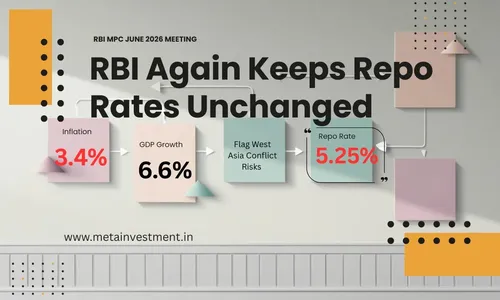
Closer to home, the RBI's Monetary Policy Committee unanimously held the repo rate at 5.25% in June while cutting its FY27 GDP growth forecast to 6.6% and raising its CPI inflation forecast to 5.1%. The next MPC meeting is scheduled for 3-5 August 2026.
The common thread: the easing cycle of 2024-25 has paused almost everywhere, and in several committees the dissents now lean hawkish. Future policy actions will depend on incoming economic data, and both further tightening and continued holds remain possible scenarios rather than expectations.
Why This Matters for Gold and Silver
Gold pays no coupon and no dividend. Its appeal is therefore heavily influenced by what an investor gives up by holding it — the real interest rate, meaning the nominal yield minus inflation. When real yields rise, that opportunity cost rises. When they fall, gold becomes relatively more attractive to hold.
That mechanism has been visible through 2026. Gold reached a record high of USD 5,608.35 per ounce on 29 January 2026, then corrected through the spring on hawkish Federal Reserve signals and reduced safe-haven demand, trading near USD 4,045 on 28 July 2026 — still around 21.6% higher year on year. Following the Fed's hold, gold moved up to around USD 4,130 per ounce during the 30 July session.
Silver's swing has been sharper. Silver was trading around USD 58.55 per ounce in July, roughly 52% below its January all-time high of USD 121.62. Silver behaves partly as a precious metal and partly as an industrial input, which historically makes it more volatile than gold in both directions.
The Indian twist
Domestic prices tell a different story from the dollar charts. On 30 July 2026, 24K gold in India was quoted at approximately Rs 1,42,560 per 10 grams while silver 999 fine was around Rs 2,16,750 per kg. By 31 July, 24K gold was available around Rs 1,44,340 per 10 grams even as MCX futures softened.
The reason domestic gold has held up better than the dollar price is arithmetic, not sentiment: Indian gold price ≈ international price × exchange rate + duty + local premium. A weaker rupee cushions the fall in the dollar price of gold for Indian buyers — and equally, it amplifies gains. Investors evaluating gold exposure may find it useful to distinguish between the metal's own price move and the currency effect layered on top of it — our gold investment guide walks through how Sovereign Gold Bonds, gold ETFs, and physical gold compare as ways to hold that exposure.
The Rupee Channel
USD-INR was trading around 95.5 at the end of July 2026, having ranged between roughly 94.52 and 96.66 over the preceding month, and about 9.1% weaker over the past year.
The mechanics are worth understanding. When US rates stay elevated relative to other economies, dollar assets can draw global capital, which supports the dollar and pressures emerging market currencies. But the rupee is not a simple derivative of Fed policy. Crude oil prices matter enormously for India's import bill, as do foreign portfolio flows, the trade balance, and RBI's own operations in the currency market.
For different Indian households, the same rupee move cuts differently:
- Importers and overseas students: a weaker rupee raises the rupee cost of dollar-denominated expenses such as tuition and travel.
- IT and pharma exporters: dollar revenue converts into more rupees.
- NRIs remitting to India: each unit of foreign currency converts into more rupees; the reverse applies when converting rupee assets back.
- Domestic investors with international fund exposure: currency movement forms part of the total return, separate from the underlying assets' performance.
What Indian Investors May Reasonably Take From This
None of the above amounts to a signal to act. A few observations may be useful:
- A single meeting is one data point. Central banks meet six to eight times a year. Portfolio decisions built around one outcome tend to be fragile.
- Interest rate risk works both ways. Longer-duration debt categories are generally more sensitive to changes in interest rates and may experience greater NAV volatility when yields rise. Different duration categories may behave differently depending on rate movements and investor objectives — see our fixed income options for how current bond, NCD, and FD rates compare across tenures.
- Gold's role is as a diversifier, not a return engine. The 2026 round trip — from a record in January to a substantial correction by mid-year — is a reminder that gold can go through extended drawdowns.
- Currency exposure is a real exposure. International funds, overseas education goals and NRI portfolios all carry currency risk that sits alongside market risk.
- Asset allocation does the heavy lifting. Investors may review their asset allocation with their financial adviser in line with their goals and risk profile rather than in response to headlines.
Key Takeaways
- The US Fed held rates at 3.50%-3.75% on 29 July 2026 in a divided 9-3 vote, with three members favouring a hike.
- The Bank of England held at 3.75% (6-3), the ECB held at 2.25%, and the Bank of Japan raised to 1.00% in June — the global easing cycle has paused.
- The RBI held the repo rate at 5.25% in June with a neutral stance; its next review is 3-5 August 2026.
- Gold near USD 4,100 per ounce remains well below its January record, while Indian gold prices around Rs 1,42,000-1,44,000 per 10 grams are supported by a weaker rupee.
- Silver near USD 58 per ounce is roughly half its January peak, illustrating its higher volatility.
- USD-INR near 95.5 is about 9% weaker year on year, with crude prices and capital flows as important as Fed policy.
Interested in Investing? Connect with Meta Investment
Meta Investment is a financial product distribution and services firm. If you'd like to explore whether a financial product is the right fit for your portfolio, our team will walk you through the details, help you assess suitability, and guide you through the onboarding process.
Nothing in this article constitutes a recommendation to buy, sell or hold any security, commodity or currency.
Market data, price levels and policy rates cited in this article reflect information available as at 31 July 2026 and are subject to change. Readers should verify current figures independently before acting on them.
Tax treatment of gold, currency gains and mutual fund investments varies by instrument, holding period and residential status. Readers should consult a qualified tax adviser regarding their own position.
Frequently Asked Questions
What did the US Federal Reserve decide at its July 2026 meeting?
At the meeting concluded on 29 July 2026, the US Federal Open Market Committee (FOMC) voted 9-3 to keep the federal funds rate unchanged in the 3.50%-3.75% range. This was the fifth consecutive hold. The three dissenting votes came from regional Federal Reserve Bank presidents who preferred an immediate rate increase.
Why did three FOMC members vote for a rate hike?
The dissenting members were concerned that inflation remains above the Fed's 2% target, particularly after energy prices rose sharply during the conflict in the Middle East. Their vote reflects a view that policy may need to be tightened rather than held. The majority preferred to wait for more inflation data before acting.
What is the federal funds rate in simple terms?
The federal funds rate is the interest rate at which US banks lend to each other overnight. The Federal Reserve sets a target range for it. Because it is the anchor for almost every other US interest rate, changes flow through to US bond yields, the US dollar, and by extension to global asset prices including gold and emerging market currencies.
What is a 'dot plot' and why do markets watch it?
The dot plot is a chart published four times a year by the US Federal Reserve showing where each policymaker individually expects the federal funds rate to be at the end of the current year and subsequent years. It is a projection, not a promise. The July 2026 meeting did not produce one; the next Summary of Economic Projections is scheduled with the September meeting.
How do US interest rates affect gold prices?
Gold pays no interest or dividend. When US interest rates and bond yields rise, the opportunity cost of holding a non-yielding asset increases, which can weigh on gold. When rates fall or are expected to fall, that opportunity cost drops. Gold prices are also influenced by geopolitical risk, central bank buying, currency movements and physical demand, so rates are only one of several drivers.
What is a 'real interest rate'?
The real interest rate is the nominal interest rate minus the inflation rate. If a bond yields 4.5% and inflation is 3%, the real return is roughly 1.5%. Real rates matter for gold because they represent what an investor gives up by holding an asset that generates no income.
Where do gold and silver prices stand as of end-July 2026?
International spot gold was trading in the region of USD 4,030-4,130 per ounce in the sessions around the Fed decision, below the record high near USD 5,600 per ounce recorded in late January 2026. Silver was trading near USD 58-59 per ounce, well below its January record of USD 121.62. In India, 24K gold was quoted around Rs 1,42,000-1,44,000 per 10 grams and silver in the Rs 2,16,000-2,19,000 per kg range in the same period.
Why are Indian gold prices near record levels when global gold has corrected?
Indian gold prices are a function of the international dollar price, the USD-INR exchange rate, import duty and local demand. Even when the dollar price of gold falls, a weaker rupee raises the rupee cost of the same ounce of gold. This currency effect is why domestic and international gold charts can look different.
What did other major central banks do recently?
The Bank of England held Bank Rate at 3.75% on 30 July 2026 with a 6-3 vote, three members favouring a hike. The European Central Bank held its deposit rate at 2.25% on 23 July after a 0.25 percentage point increase in June. The Bank of Japan raised its policy rate by 25 basis points to 1.00% on 16 June 2026, its highest level since 1995. Broadly, the global easing cycle has paused.
Where does the RBI stand and when is the next policy meeting?
At its June 2026 review, the Reserve Bank of India kept the policy repo rate unchanged at 5.25% with a neutral stance, while lowering its FY27 GDP growth projection to 6.6% and raising its CPI inflation projection to 5.1%. The next scheduled Monetary Policy Committee meeting is 3-5 August 2026.
How does a Fed decision affect the Indian rupee?
When US rates stay high relative to other economies, dollar-denominated assets can attract global capital, supporting the US dollar. That tends to put pressure on emerging market currencies including the rupee. Crude oil prices, foreign portfolio flows, India's trade balance and RBI intervention are equally important drivers, so the relationship is not one-to-one.
How does a weaker rupee affect NRIs sending money to India?
A weaker rupee means each unit of foreign currency converts into more rupees, which raises the rupee value of a remittance. The flip side is that NRIs with rupee-denominated assets see a lower value when converted back into foreign currency. Currency movement affects different NRI situations in different directions, and the appropriateness of any remittance or investment decision depends on individual circumstances.
Should Indian investors change their portfolio because of a US Fed decision?
A single central bank meeting is one input among many. Investors may review their asset allocation with a financial adviser in the context of their own goals, risk appetite and investment horizon rather than in reaction to a single event. The suitability of any investment category depends on individual financial circumstances.
Does gold belong in an Indian investor's portfolio?
Gold is used by some investors as a diversifier because its returns have historically shown low correlation with equities over certain periods. It generates no income and can go through long periods of flat or negative returns, as the correction from the January 2026 record illustrates. Whether and how much gold is appropriate depends on an investor's overall asset allocation, goals and risk tolerance.
What are multi-asset allocation funds and how do they relate to this?
Multi-asset allocation funds are a SEBI-defined mutual fund category that invests across at least three asset classes, typically equity, debt and commodities such as gold, with a minimum allocation to each. They are one structure through which investors access more than one asset class within a single scheme. Suitability depends on the investor's goals, horizon and risk profile, and all scheme documents should be read before investing.


Mutual fund updates, SIP tips, and what's moving the market. No daily noise — only when there's something worth reading.
Read more about
- Better returns with Bonds
- Happy Akshaya Trithiya
- All About AIFs (Alternative Investment Funds)
- Lucrative Investment Opportunities Options for NRIs in India
- PMS in India: A Guide to Portfolio Management Services
- Gold vs FD: Exploring the Pros and Cons
- Asset Allocation with Sovereign Gold Bonds (SGBs)
- Sovereign Gold Bond 2023 Tranch II
- Sovereign Gold Bond 2023-24 Series III is now open for subscription.
- Earn More Than Traditional Fixed Income with Market-Linked Debentures
- A Fresh Perspective on Portfolio Management Services (PMS) for NRI/HNI Investors
- Gold: A Timeless Investment - How Mutual Funds Make It Easier
- Peer-to-Peer Lending: A New Era for Indian Investors?
- Abans Global Arbitrage Fund: A Deep Dive
- Considering a positive outlook for TCS or Titan? These new MLDs might be for you!
- 10.10% MUTHOOT FINCORP NCD Open for Subscription
- 10.75% Sammaan Capital Ltd NCD Open for Subscription
- Don't invest this Diwali
- 📢📢 Buy gold in a new avatar, this Dhanteras!
- The Ever-Shifting Sands: Why Asset Allocation is Key to Investment Success
- Two Great Fixed-Income Investment Opportunities to Lock in High Returns
- RBI Cuts Repo Rate for the First Time in 5 Years
- Gold Investments: A Casual WhatsApp Group Discussion of Friends (Ft. Bachat Babu’s Wisdom)
- Unlock High Returns with Sammaan Capital Limited’s Secured NCDs – Tranche III Public Issue Now Open!
- From Cricket to Code to Fitness: Investment Lessons from India’s ICC Champions Trophy 2025 Win
- How to Become an Accredited Investor in India: A Guide for HNIs | SEBI Framework
- Edelweiss NCDs 2025 – Secure 9.5% to 11% Returns | Best Fixed-Income Investment
- Edelweiss Gold Structured Products: A Smart Way to Invest in Gold with Principal Protection
- Estate Planning in India: Wills, Trusts & Tax Tips for NRIs & Residents
- Mutual Will: Why Married Couples Must Have One | Estate Planning Guide
- Understanding Beneficial Nominee in Insurance & Its Role in Estate Planning
- NRI Mutual Fund Taxation: How DTAA Can Save You Tax (Anushka Shah Case)
- Gold vs. Mutual Funds vs. Multi-Asset Funds: Best Investment for Akshaya Tritiya 2025
- Mirae Asset Global Allocation Fund - Invest in Global Markets via GIFT City | Tax Benefits for NRIs & HNIs
- The Ultimate Guide to Investing in Silver: Digital, ETFs, and Physical Options
- Adani Enterprises NCDs 2025 – Safe Investment with 9.3% Returns?
- From Freedom Fighters to Financial Freedom: Gen Z Investing & Independence Day Lessons
- All Weather Gold: A Principal-Protected Way to Bet on Gold (Until Aug 31)
- ESAF SFB NCD Issue: 11.30% Coupon | Basel II Compliant Bonds
- Diwali Investment 2025: Brighten Your Financial Future with Indel Money Secured NCD | High Yield Fixed Income for Pune Investors
- Light Up Your Finances This Diwali: A Guide to Wealth, Wisdom, and Long-Term Prosperity
- Diviniti Equity Long Short Fund NFO 2025 | Investment for Indian HNIs & NRIs
- The Investor and The Distributor: A Lesson on SIP Discipline
- Financial Wellness for Men: Boost Health with Smart Investing, SIP & Retirement Planning
- Kotak Market Outlook 2026: India Equity, Debt, Gold & Silver
- Year-End Review: Mutual Fund Categories & Performance Explained
- Minor Folio in Mutual Funds: Secure Your Child's Financial Future
- Adani Enterprises NCD 2026: 8.9% Yield, Secure Options for Retail Investors | Apply Now
- PFC NCD Issue Jan 2026: AAA Rated Bonds Offering up to 7.30%
- RBI Policy Feb 2026: Repo Rate, New CPI Series & Your Wallet | Analysis
- SEBI Equity Fund Rules 2026: Multi Cap, Flexi Cap Changes
- SEBI Debt Fund Rules 2026: Debt Funds Masterclass - Duration, Credit Risk, Yields Guide
- SEBI's New Voluntary Lock-in for Mutual Fund Folios: What Every Investor Must Know
- ICICI Pru Thematic Advantage Fund: What the Recategorization Means for You
- SEBI's New Voluntary Lock-in for Mutual Fund Folios: What Every Investor Must Know
- Form 121: The New TDS Declaration That Replaces Form 15G & 15H
- NRI Mutual Fund KYC in 2026: The Ultimate Compliance Handbook
- NPS Retirement Income Schemes (RIS) & Drawdown Options Explained
- Electronic Gold Receipts (EGR): NSE's New Way to Own Gold Digitally
- Marcellus Global Equities Fund NFO: Invest in Global Markets via GIFT City
- Short-Term Goals: Where to Park Your Money in India
- RBI's New Conduct Rules for Banks: What Investors Must Know
- EPF Scheme 2026 Explained: New PF Rules, Withdrawals & NPS Comparison
- Senior Citizen Savings Scheme: New Rules from 1 July 2026
- Tata AIA Sampoorna Care – Cancer & Cancer Fund Explained
- FCNR Deposits Explained: A Dollar FD Guide for NRIs
- SEBI Extends SWP/STP Facility to Demat Mutual Fund Units
- SEBI Simplifies Mutual Fund Transmission: What Changes for Nominees and Legal Heirs
- Cross-Border Motor Insurance: What the Supreme Court's 2026 Ruling Means
- AMFI Stock Reclassification: What It Means for Your Fund
- FTSE India Index Explained: What It Is & Why It Matters Now
- Pune on India's Wealth Map: What the 2026 List Reveals
- Closing Auction Session: Why Arbitrage Fund NAVs Jumped
- Emergency Fund: The Money That Buys the Right to Say No
- The 8 Freedoms Checklist for Financial Independence
- SEBI's Proposed MF-Only PMS: What Investors Should Know
- Your Increment Came Through. Did Your SIP?
- SEBI Mandatory Nomination Rules for Demat and MF Folios
- Record SIP Inflows in a Falling Month: Reading August's AMFI Data
- UPI Charges Above ₹2,000: What Changes on October 15
- एडलवाइस NCD 2025 – 9.5% ते 11% सुरक्षित परतावा | सर्वोत्तम निश्चित उत्पन्न गुंतवणूक
- एडलवाईस गोल्ड स्ट्रक्चर्ड प्रॉडक्ट्स: मुद्दल सुरक्षित ठेवून सोन्यात गुंतवणूक करण्याचा हुशार मार्ग
- भारतात एस्टेट प्लॅनिंग: NRI आणि रहिवाशांसाठी इच्छापत्र, ट्रस्ट आणि कर टिप्स
- म्युच्युअल विलः विवाहित जोडप्यांसाठी का आवश्यक? | एस्टेट प्लॅनिंग मार्गदर्शक
- विमा योजनांमध्ये लाभार्थी नामनिर्देशित व्यक्ती (बेनिफिशियरी नॉमिनी) आणि एस्टेट प्लॅनिंगमधील त्याची भूमिका
- NRI म्युच्युअल फंड कर: DTAA मदतीने कसे कर बचत करू शकता (अनुष्का शहा केस)
- सोने vs म्युच्युअल फंड vs मल्टी-अॅसेट फंड: अक्षय तृतीया २०२५ साठी सर्वोत्तम गुंतवणूक
- मिराए अॅसेट ग्लोबल अलोकेशन फंड - गिफ्ट सिटी मार्गे जागतिक बाजारात गुंतवणूक | एनआरआय आणि एचएनआय साठी कर फायदे
- स्काय वन कॉर्पोरेट पार्क: HNIs आणि NRIs साठी एक उत्तम गुंतवणूक संधी
- RBI चे बँकांसाठी नवे वर्तन नियम: गुंतवणूकदारांनी काय जाणून घ्यावे
- Demat आणि MF Folio साठी SEBI चे अनिवार्य Nomination नियम
- ₹2,000 वरील UPI शुल्क: 15 ऑक्टोबरपासून काय बदलते

This communication is intended solely for general educational and informational purposes. The information provided is general in nature and does not take into account the specific financial goals, risk profile, investment horizon, financial circumstances or other requirements of any particular investor. It should not be construed as personalised investment advice or as a recommendation to buy, sell or hold any specific financial product.
International investments may carry currency/exchange-rate, foreign-market, geopolitical, taxation, regulatory, remittance and liquidity risks.
Distributor Disclosure: Where this content is provided by a distributor/intermediary, any applicable commission, remuneration, affiliation or other material conflict of interest shall be disclosed separately. The availability of a product through the distributor does not by itself imply that the product is suitable for every investor.
No Guarantee: No statement on this page should be interpreted as a promise, assurance or guarantee of returns or investment outcomes.
Meta Investment – Your Investment and Insurance Companion